
The 2026 RAM Crisis Is Getting Worse: What the Latest DDR4 and DDR5 Shortage Means for PC Hardware
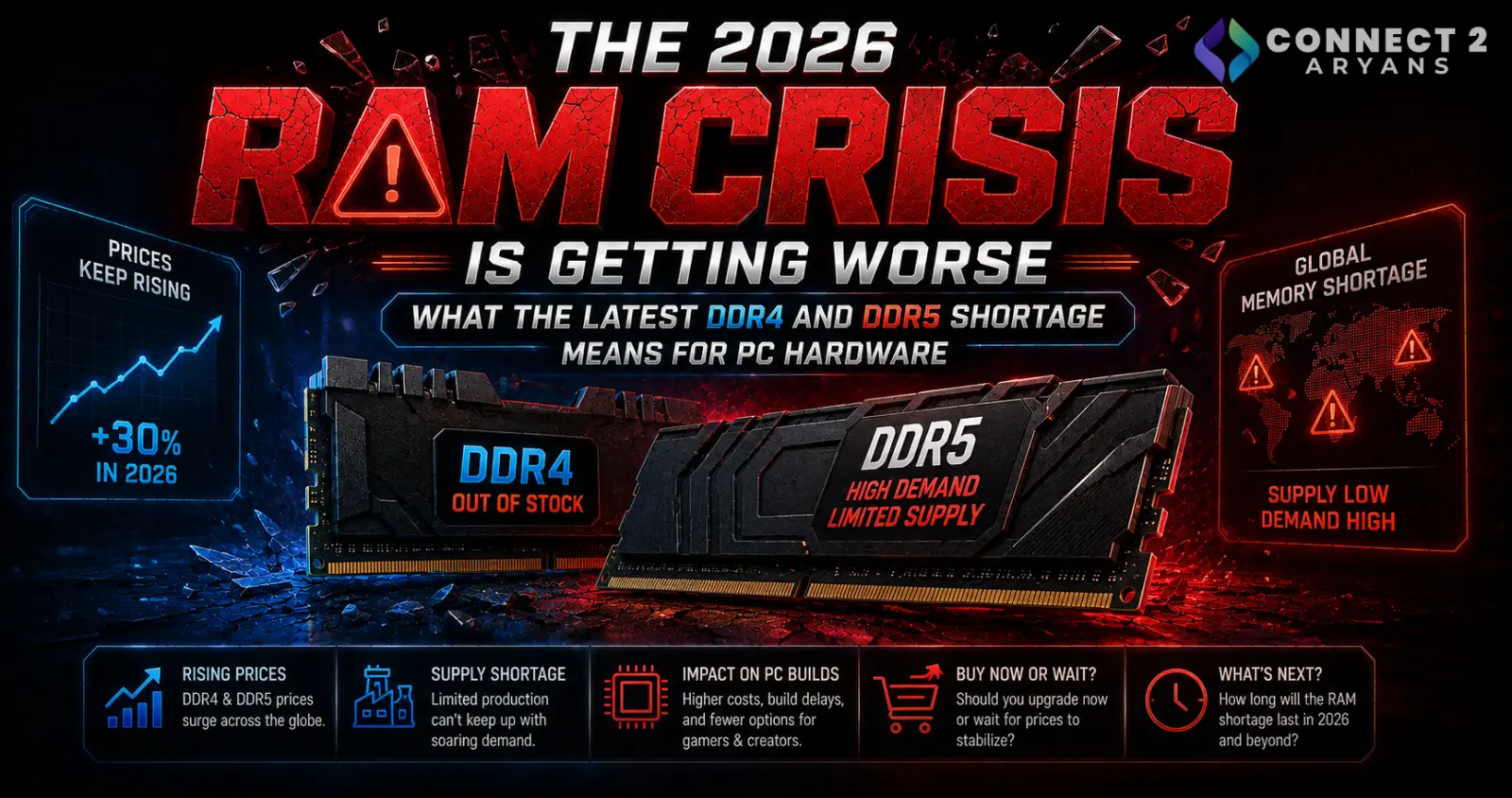
The 2026 RAM Crisis Is Getting Worse: What the Latest DDR4 and DDR5 Shortage Means for PC Hardware
The global memory crisis isn't going away.
In fact, the latest reports suggest the situation could remain painful for PC builders considerably longer than many buyers originally expected.
Fresh reporting in August 2026 indicates that the shortage affecting the memory industry has deepened, with major manufacturers warning about continuing supply constraints and the possibility of an even more difficult market in 2027.
This is no longer simply a story about expensive DDR5 kits.
Pressure is being felt across DDR4, DDR5 and other parts of the memory market, while the effects are increasingly spilling into other hardware categories.
Graphics cards, SSDs, laptops and complete PCs can all be affected when memory becomes more expensive and manufacturers compete for limited semiconductor production.
For PC builders in Pakistan, this raises an important question:
How much worse could the 2026 memory crisis get—and what should you do if you're planning a new PC?
The RAM Crisis Has Entered a New Stage
The memory market has already been under severe pressure throughout 2026.
But the latest concern is duration.
Earlier in the crisis, buyers could reasonably hope that additional production and changing demand would begin stabilizing prices relatively quickly.
The outlook now looks less certain.
Recent reporting indicates that Samsung expects memory shortages to continue, with conditions potentially becoming even more difficult in 2027. Some industry forecasts suggest supply constraints could extend much further.
That changes the situation considerably.
A short-term price spike is one thing.
A multi-year period of constrained memory supply can influence the design and pricing of entire generations of PCs.
AI Remains at the Center of the Memory Problem
The enormous expansion of artificial-intelligence infrastructure continues to reshape the semiconductor industry.
AI servers require extraordinary amounts of memory.
That includes high-performance memory used alongside AI accelerators as well as conventional server DRAM.
Companies building large AI data centers are therefore competing for semiconductor production capacity at a scale that the consumer PC market hasn't traditionally faced.
For memory manufacturers, enterprise and AI customers can represent extremely large and valuable orders.
That creates a difficult situation for ordinary PC hardware.
Manufacturing capacity isn't unlimited.
If more production is directed toward high-demand AI and server products, consumer memory supply can remain constrained.
DDR5 Is Still Under Heavy Pressure
DDR5 has become the standard memory technology for many modern desktop platforms.
AMD's AM5 platform uses DDR5, while newer Intel platforms also rely heavily on DDR5.
That means higher DDR5 prices don't only affect someone upgrading from 16GB to 32GB.
They affect the entry cost of an entire modern PC platform.
Consider a new gaming build.
You need:
Processor + Motherboard + DDR5 RAM + GPU + SSD + PSU + Cooling
If memory becomes substantially more expensive, the total cost of moving to a newer CPU platform rises even if the CPU itself hasn't changed price.
This is one reason the RAM crisis has become much more important than a normal component-price fluctuation.
Modern AM5 Builds Depend on DDR5
AMD's AM5 ecosystem is a good example.
Current X870 and X870E motherboards use DDR5 memory.
Browse Motherboards on Connect2Aryans
Connect2Aryans currently lists modern AM5 boards including X870 and X870E models with DDR5 support, PCIe 5.0 connectivity and current Ryzen processor compatibility.
When calculating the cost of an AM5 gaming PC, RAM therefore needs to be considered as part of the platform rather than an inexpensive component added at the end.
DDR4 Isn't Escaping the Crisis Either
You might expect the obvious solution to be:
Forget DDR5 and build a cheaper DDR4 PC.
Unfortunately, DDR4 has its own supply problems.
DDR4 is an older technology, and manufacturers have gradually shifted production priorities toward newer and more profitable memory products.
At the same time, demand for affordable DDR4 systems hasn't disappeared.
That creates an unusual market situation:
DDR4 is older, but shrinking supply can prevent it from becoming progressively cheaper.
Recent RAM-market reporting shows that DDR4 prices have also faced significant upward pressure during the current shortage.
This is especially important for budget PC builders.
Older memory doesn't automatically mean cheaper memory anymore.
DDR4 Platforms Still Have One Important Advantage
Despite the supply problems, DDR4 platforms remain relevant because there are still many compatible processors and motherboards available.
Intel's LGA1700 ecosystem is a good example.
Some 12th, 13th and 14th Gen Intel processors can be paired with either DDR4 or DDR5 depending on the motherboard.
That gives builders flexibility.
View MSI PRO B760M-P DDR4 on Connect2Aryans
The live Connect2Aryans listing confirms this B760 motherboard supports DDR4 memory and LGA1700 processors.
For someone who already owns a good DDR4 kit, reusing that memory could reduce the cost of an upgrade.
But buying a completely new DDR4 system purely because you assume RAM will always be cheaper deserves more careful comparison in the current market.
DDR5 Motherboards Are Becoming the New Normal
At the same time, DDR5 motherboard availability continues expanding.
Even relatively affordable motherboard tiers now include DDR5 options.
View MSI PRO B760M-E DDR5 on Connect2Aryans
Connect2Aryans' live listing identifies the board as an LGA1700 B760 platform with DDR5 memory support.
This creates an important buying decision in 2026:
Do you save money with an older DDR4 platform, or pay more to move onto DDR5?
There is no universal answer.
The correct decision depends on the complete cost of the CPU, motherboard and memory combination.
The RAM Crisis Is Starting to Affect GPUs Too
One of the biggest developments is that the memory problem isn't staying inside system RAM.
Graphics cards require their own dedicated video memory.
Modern GPUs can use technologies such as:
- GDDR6
- GDDR6X
- GDDR7
depending on the graphics-card generation.
Recent reports have linked rising memory costs with additional pressure on graphics-card pricing, with some manufacturers and distributors already implementing substantial GPU price increases in parts of Asia.
We've already seen reports involving Gigabyte graphics cards receiving major distributor-level increases in Japan.
That makes the RAM crisis relevant even to someone who isn't buying desktop RAM.
Why GPU Memory Matters So Much
Modern gaming GPUs increasingly carry large amounts of VRAM.
Current graphics cards commonly offer capacities such as:
- 8GB
- 12GB
- 16GB
- 24GB
- 32GB
Every additional memory chip contributes to manufacturing cost.
If the price of graphics memory increases substantially, manufacturers eventually have to decide whether to:
absorb the cost, reduce margins, change specifications, or increase GPU prices.
For high-end graphics cards carrying large amounts of fast VRAM, that cost can become particularly significant.
SSDs Are Caught in the Memory Crisis Too
RAM isn't the only memory inside a computer.
SSDs rely on NAND flash memory rather than DRAM for primary data storage.
NAND and DRAM are different technologies, but both exist within a semiconductor industry experiencing extraordinary demand and changing production priorities.
Recent reporting shows SSD prices have also become significantly more difficult for PC builders, with examples of drives selling dramatically above previous low prices.
This creates another problem.
Historically, falling SSD prices helped offset the increasing cost of other PC components.
Builders could often afford:
1TB → 2TB → 4TB
as NAND prices declined.
If storage becomes expensive at the same time as RAM and GPUs, balancing a gaming-PC budget becomes much harder.
The Entire PC Build Is Being Squeezed
This is the most important part of the 2026 memory crisis.
The problem is no longer:
“RAM costs too much.”
It is becoming:
“Memory costs are making several PC components more expensive simultaneously.”
Consider a gaming build.
RAM
DDR4 and DDR5 prices are under pressure.
Graphics Card
VRAM costs can influence GPU manufacturing.
SSD
NAND pricing affects storage.
Laptop
Contains RAM, SSD storage and often dedicated or integrated graphics memory.
Prebuilt PC
Contains all of the above.
The result is a broader increase in the cost of computing hardware.
Laptops Could Feel the Pressure Particularly Hard
Laptops are vulnerable because manufacturers purchase enormous quantities of memory and storage.
A modern notebook can include:
- LPDDR5/LPDDR5X or DDR5
- NVMe SSD
- Dedicated VRAM on gaming models
- Integrated memory configurations
If several of those components become more expensive simultaneously, laptop manufacturers have limited options.
They can:
Increase prices
or
Reduce specifications
or
Accept lower margins.
This could make configurations such as 16GB RAM + 512GB SSD remain common for longer than buyers might otherwise expect.
Could PCs Start Shipping With Less RAM?
It's possible that prolonged high memory prices could influence system configurations.
Manufacturers constantly balance specifications against target retail prices.
If memory becomes too expensive, some entry-level PCs may continue using smaller capacities to maintain affordable price points.
That doesn't mean the entire industry will suddenly return to 8GB.
But component prices directly influence how manufacturers configure mass-market systems.
For PC enthusiasts building their own desktops, this is less restrictive because memory can usually be selected independently.
Laptop buyers have less flexibility, especially when RAM is soldered.
Don't Assume DDR4 Will Disappear Immediately
Before the memory crisis, the industry appeared to be moving steadily toward DDR5.
The current situation makes the transition more complicated.
There remains an enormous installed base of DDR4 systems.
Millions of PCs still use platforms including:
- AMD AM4
- Intel LGA1200
- Intel LGA1700 DDR4
These computers don't suddenly stop working because DDR5 exists.
For someone already using a capable DDR4 system, keeping it longer may actually make financial sense during a period of expensive hardware.
You don't need to replace a working platform simply because a newer memory standard exists.
Is It Worth Upgrading RAM Right Now?
Only if you actually need it.
The shortage doesn't mean everyone should immediately buy more memory.
Consider upgrading if:
- Your system regularly runs out of RAM.
- Games or applications are stuttering because of memory pressure.
- You need additional capacity for professional workloads.
- You're already building a new PC.
- Your current memory configuration is limiting performance.
Don't upgrade simply because you're afraid RAM might become more expensive.
Buying unnecessary hardware at a high price isn't saving money.
16GB vs 32GB Becomes a More Important Decision
When memory was cheap, moving from 16GB to 32GB was an easy recommendation for many PC builders.
In an expensive market, the decision requires more thought.
16GB
Can still be suitable for many mainstream systems and gaming workloads depending on software requirements.
32GB
Provides more headroom for modern gaming, heavy multitasking and content creation.
64GB+
Makes sense primarily when your workload actually requires it.
The correct capacity depends on what you run.
Don't sacrifice your graphics-card budget simply to install an unnecessarily large amount of RAM.
What Should Pakistani PC Builders Do?
Pakistan adds another layer of complexity because most major PC components are imported.
Local prices can be influenced by:
- International hardware costs
- USD/PKR exchange rate
- Import costs
- Shipping
- Distributor pricing
- Existing stock
- Replacement inventory
This means a global memory increase doesn't instantly translate into an identical Pakistani retail increase.
There can be a delay.
Existing inventory may have been purchased at older prices.
But once that inventory sells, replacement stock can arrive at a different cost.
That's why buyers sometimes see large price differences between stores during rapidly changing hardware markets.
Compare Complete Platform Cost Before Buying
The best strategy in 2026 is to stop comparing components individually.
Instead of:
DDR4 vs DDR5
compare:
CPU + Motherboard + RAM
Instead of:
RTX vs Radeon
compare:
GPU price + performance + VRAM + PSU requirements
Instead of:
1TB vs 2TB SSD
compare:
actual storage requirements + current price per capacity
A balanced PC remains more important than maximizing one specification.
Should You Build a PC Now or Wait?
There is no universal answer.
Waiting makes sense if:
- Your current PC works well.
- You don't need additional performance.
- Current prices exceed your budget.
- You're waiting for a specific upcoming product.
Building now makes sense if:
- You actually need a computer.
- Your current PC can't handle your workload.
- You've found suitable hardware within your budget.
- You need the system for work, gaming or study now.
The latest memory-market outlook makes one thing increasingly clear:
Don't automatically assume waiting several months guarantees cheaper RAM.
Recent industry warnings suggest memory supply could remain difficult into 2027 and potentially beyond.
Could RAM Prices Eventually Fall Again?
Yes.
The semiconductor industry operates in cycles.
High prices encourage manufacturers to expand production, while demand can eventually change.
New manufacturing capacity can ultimately improve supply.
The problem is timing.
Building semiconductor fabrication capacity isn't fast.
Even when manufacturers announce major investments, factories must be constructed, equipped, qualified and ramped before large volumes of memory reach the market.
That's why new investment doesn't necessarily solve today's shortage.
Why 2027 Is Becoming the Bigger Concern
The most worrying part of the latest reporting isn't necessarily today's retail RAM price.
It's what memory manufacturers are saying about future supply.
Recent reports cite warnings that 2027 could become an especially difficult year from a supply perspective, while some projections suggest the wider shortage could persist beyond that.
Forecasts can change.
Demand could weaken.
Production could improve faster than expected.
But these warnings suggest PC builders shouldn't treat the current shortage as a temporary anomaly guaranteed to disappear within a few months.
Frequently Asked Questions
Why is there a RAM shortage in 2026?
Strong AI and data-center demand is consuming enormous amounts of memory capacity while manufacturers balance production between consumer, server and advanced memory products. This has contributed to tight supply and higher prices across the memory market.
Is DDR5 affected by the shortage?
Yes. DDR5 pricing and supply have been heavily affected during the current memory crisis, with substantial price increases reported throughout the market.
Is DDR4 also becoming expensive?
Yes. DDR4 hasn't been immune. Reduced production emphasis combined with continuing demand has contributed to price pressure on older memory as well.
Will RAM prices fall in 2027?
There is no guarantee. Recent industry reporting actually warns that supply conditions could remain difficult or worsen during 2027.
Is the RAM shortage affecting graphics cards?
The broader memory shortage is increasingly relevant to GPUs because graphics cards require dedicated VRAM. Recent reports have connected rising memory costs with additional pressure on graphics-card pricing.
Are SSD prices affected too?
SSDs use NAND rather than conventional DRAM for their primary storage, but storage pricing is also under significant pressure in the current semiconductor market. Recent retail examples show dramatically higher SSD costs compared with previous lows.
Should I buy DDR4 or DDR5 in 2026?
Choose based on your complete platform. If you already own compatible DDR4, reusing it can reduce upgrade costs. For a new modern platform such as AMD AM5, DDR5 is required.
Conclusion
The latest developments suggest the 2026 RAM crisis is evolving from a temporary price problem into a much broader PC hardware issue.
DDR5 remains expensive.
DDR4 isn't immune.
And increasingly, the consequences extend beyond desktop memory into GPUs, SSDs, laptops and complete gaming PCs.
The biggest concern now is how long the shortage could continue.
Recent reports point toward difficult supply conditions extending into 2027, with some industry warnings stretching even further.
For PC builders in Pakistan, panic-buying isn't the answer.
Instead, compare the complete platform cost, avoid unnecessary upgrades and pay attention to international hardware trends because replacement inventory can eventually reflect higher global costs.
If you're already planning a PC, focus on getting the capacity you actually need rather than overbuying memory simply because prices might rise.
Explore Motherboards on Connect2Aryans
Explore Graphics Cards on Connect2Aryans
Browse PC components and upgrade options on Connect2Aryans, with warranty support included.