
TCL Prepares 700Hz OLED Gaming Monitor Panels for 2028 — The Next Big Leap in Gaming Displays
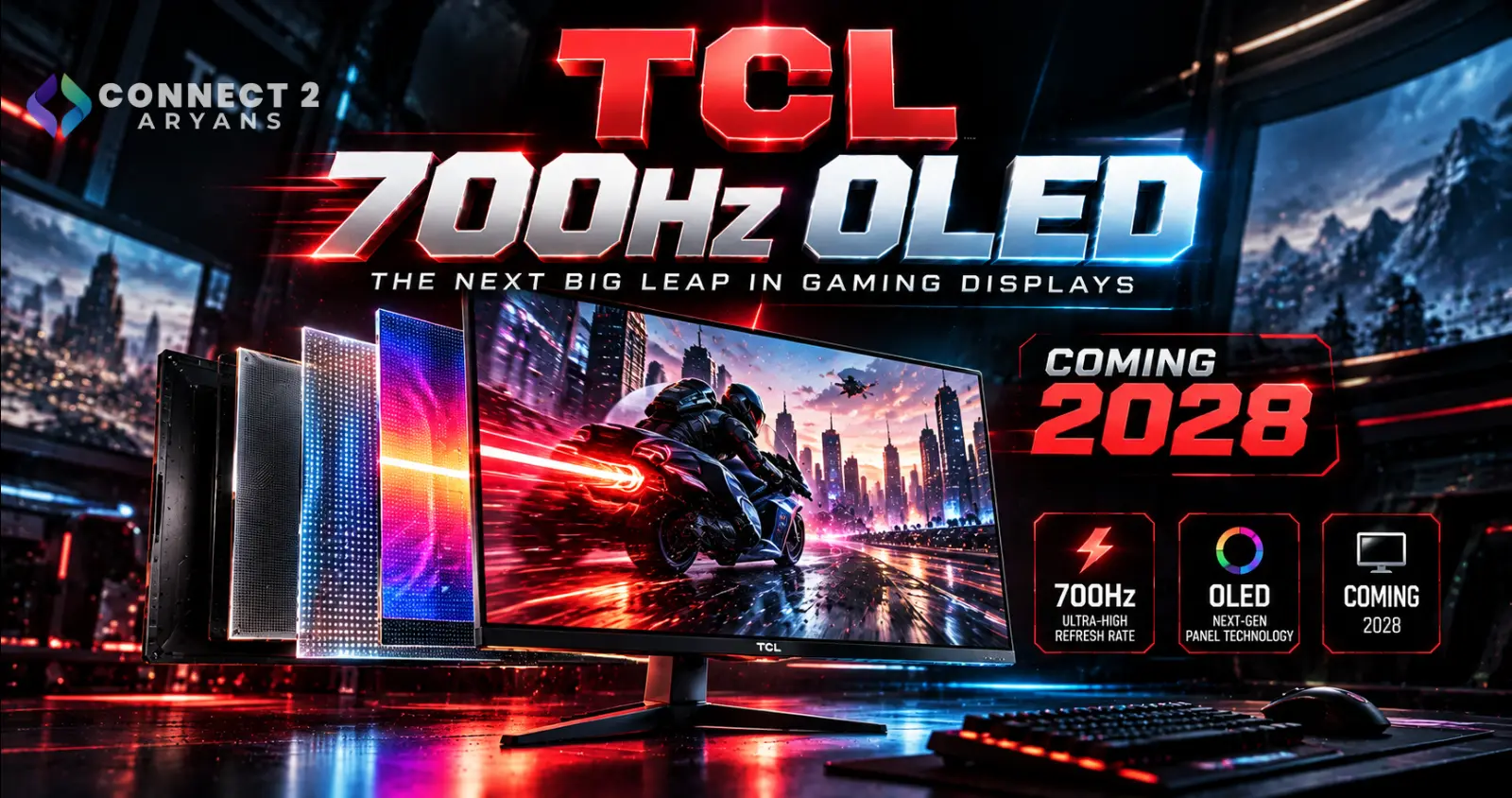
TCL Prepares 700Hz OLED Gaming Monitor Panels for 2028 — The Next Big Leap in Gaming Displays
The gaming monitor industry is preparing for another major jump in refresh rates.
According to new information reported on October 14, 2026, TCL CSOT is developing OLED monitor panels capable of reaching up to 700Hz, with production expected to begin in 2028.
The panels are reportedly being developed in 32-inch and 34-inch sizes, making the project particularly interesting for gamers who want both large displays and extremely high refresh rates.
The information comes from display-industry research firm Omdia, which has outlined TCL's plans for its upcoming Gen 8.6 OLED manufacturing facility in Guangzhou, China.
However, these are planned panel capabilities, not confirmed retail monitor specifications.
No finished 700Hz TCL gaming monitor has been announced, and important details such as resolution, pricing, connectivity and availability remain unknown.
Nevertheless, the development highlights how quickly OLED gaming-monitor technology is advancing.
With 240Hz, 360Hz and even 500Hz OLED monitors already available, manufacturers are pushing toward refresh rates that would have seemed unrealistic only a few years ago.
For PC gamers planning their next display upgrade, this raises an interesting question:
How much difference will a 700Hz OLED monitor actually make?
TCL Is Reportedly Developing 700Hz OLED Panels
TCL CSOT, also known as TCL China Star Optoelectronics Technology, is the display-manufacturing division associated with TCL.
The company produces display panels used across different product categories.
According to Omdia's reported manufacturing roadmap, TCL is preparing to expand its OLED production capabilities using a new Gen 8.6 manufacturing facility.
The upcoming production line is expected to support larger OLED monitor panels, including 32-inch and 34-inch formats.
Most importantly, the roadmap reportedly includes refresh rates reaching 700Hz.
This is an ambitious target because extremely high refresh rates are traditionally associated with smaller competitive-gaming monitors.
Larger OLED panels operating at such speeds could create new possibilities for premium gaming displays.
However, the 700Hz specification has not yet been tied to a confirmed resolution or finished monitor model.
Reported TCL OLED Development Details
| Feature | Reported Information |
|---|---|
| Manufacturer | TCL CSOT |
| Panel Technology | OLED |
| Maximum Planned Refresh Rate | Up to 700Hz |
| Planned Panel Sizes | 32-inch and 34-inch |
| Manufacturing Technology | Inkjet-Printed OLED |
| Manufacturing Facility | Gen 8.6 OLED Factory |
| Location | Guangzhou, China |
| Expected Production | 2028 |
| Resolution | Not Announced |
| Retail Monitor Models | Not Announced |
| Pricing | Not Announced |
These details describe a reported manufacturing roadmap rather than products available to purchase.
What Does 700Hz Actually Mean?
A monitor's refresh rate determines how many times its display can update each second.
A conventional 60Hz monitor refreshes its image 60 times per second.
A 144Hz monitor can refresh 144 times per second.
A 240Hz monitor increases that capability to 240 refreshes per second.
At 700Hz, the display can theoretically refresh its image 700 times every second.
That creates a very short interval between refreshes.
Refresh Rate Comparison
| Refresh Rate | Time Between Refreshes |
|---|---|
| 60Hz | 16.67ms |
| 120Hz | 8.33ms |
| 144Hz | 6.94ms |
| 180Hz | 5.56ms |
| 240Hz | 4.17ms |
| 360Hz | 2.78ms |
| 500Hz | 2.00ms |
| 700Hz | 1.43ms |
At 700Hz, each refresh interval lasts approximately 1.43 milliseconds.
This is significantly shorter than the interval on a conventional 144Hz or 240Hz gaming monitor.
However, refresh interval should not be confused with total input latency or pixel response time.
Actual responsiveness depends on several factors, including the graphics card, game engine, frame delivery, monitor electronics and pixel behavior.
For gamers comparing available displays, the existing gaming monitor collection at Connect2Aryans includes models across multiple refresh-rate categories.
Why Are Gaming Monitor Manufacturers Pushing Beyond 500Hz?
Competitive gaming has become an important driver of display development.
Games such as Counter-Strike 2, Valorant and other competitive shooters reward responsive controls and clear motion.
Professional and competitive players often prioritize high frame rates and low latency over maximum graphics settings.
This has encouraged monitor manufacturers to develop increasingly faster displays.
The industry has progressed through several major refresh-rate categories:
60Hz → 144Hz → 240Hz → 360Hz → 500Hz → 700Hz and beyond.
However, the benefits become progressively smaller as refresh rates increase.
Moving from 60Hz to 144Hz reduces the refresh interval by approximately 9.7 milliseconds.
Moving from 500Hz to 700Hz reduces it by only about 0.57 milliseconds.
That difference can still matter in specialized competitive environments, but it is much smaller than the improvement experienced when upgrading from a basic 60Hz monitor.
700Hz OLED vs 500Hz OLED: How Big Is the Difference?
The difference between 500Hz and 700Hz is measurable.
A 500Hz display has a refresh interval of 2 milliseconds.
A 700Hz display reduces that interval to approximately 1.43 milliseconds.
That represents a reduction of around 28.6% in the time between refreshes.
However, this does not automatically translate into a 28.6% improvement in gaming performance.
The actual benefit depends on the game's frame rate, display response characteristics and other latency sources.
Current 500Hz OLED Monitors Already Exist
For comparison, Connect2Aryans currently lists the MSI MPG 271QR QD-OLED X50, a 26.5-inch QHD gaming monitor featuring a 500Hz refresh rate.
This demonstrates that ultra-high-refresh OLED gaming is already a reality.
The upcoming TCL panels would push the refresh-rate target further while potentially introducing larger screen sizes.
Gamers interested in existing OLED technology can explore current gaming monitors rather than waiting for an unannounced 2028 product.
Why OLED Technology Matters for Competitive Gaming
OLED monitors differ fundamentally from conventional LCD monitors.
Traditional LCD displays use a backlight to illuminate liquid-crystal pixels.
OLED panels use self-emissive pixels that generate their own light.
This provides several potential advantages.
Faster Pixel Transitions
OLED panels can change pixel states very quickly.
That can help reduce visible smearing and improve motion clarity.
However, pixel response time and refresh rate remain separate specifications.
A monitor with fast pixel transitions can still have limited motion clarity if its refresh rate is low.
Deep Black Levels
OLED pixels can turn off individually.
This allows OLED displays to produce very deep blacks and high contrast.
Dark scenes can appear more convincing because the display does not need to illuminate an entire backlight zone.
Improved Contrast
OLED technology can produce strong contrast between bright and dark image elements.
This is particularly noticeable in games featuring dark environments, nighttime scenes and HDR effects.
Wide Viewing Angles
Many OLED panels maintain consistent image characteristics across relatively wide viewing angles.
However, exact performance depends on the panel design.
Potential Limitations
OLED also introduces considerations involving brightness behavior, long-term image retention and burn-in.
Modern OLED monitors incorporate protection features, but buyers should still evaluate the complete product rather than choosing solely based on panel technology.
For additional context, Connect2Aryans offers a detailed 1080p vs 1440p vs 4K gaming monitor guide covering the relationship between resolution, refresh rate and graphics performance.
TCL Is Using Inkjet-Printed OLED Technology
One of the most interesting aspects of TCL's reported plans is the manufacturing process.
The upcoming panels are expected to use Inkjet-Printed OLED, commonly abbreviated as IJP OLED.
This manufacturing approach differs from several established OLED production techniques.
Inkjet printing involves depositing organic materials using a controlled printing process.
The technology is being developed as a way to improve manufacturing efficiency and material utilization.
Why Inkjet Printing Is Important
OLED manufacturing can be expensive.
Panel production involves complex equipment, specialized materials and demanding quality-control requirements.
Improving material utilization could help manufacturers reduce certain production costs.
Inkjet printing may also provide additional flexibility when manufacturing larger panels.
However, a potentially more efficient production process does not guarantee that finished 700Hz OLED gaming monitors will be inexpensive.
Retail pricing will depend on manufacturing yields, panel specifications, brand positioning and other factors.
TCL's New OLED Factory Is Expected to Begin Production in 2028
The reported manufacturing plans center on TCL's upcoming Gen 8.6 OLED facility in Guangzhou.
According to the Omdia information cited in industry reporting, production is expected to begin in 2028.
The facility is intended to manufacture larger OLED panels using inkjet-printing technology.
This is particularly important because OLED manufacturing has historically been dominated by established display suppliers.
Additional large-scale production capacity could increase competition within the industry.
However, the 2028 production target should not be interpreted as a guaranteed consumer launch date.
Panel manufacturing, qualification, monitor development and retail distribution are separate stages.
A panel entering production does not mean finished monitors will immediately appear in stores.
Will TCL's 700Hz OLED Monitor Be 4K?
This is one of the biggest unanswered questions.
The reported roadmap does not confirm the resolution at which the 700Hz refresh rate would operate.
That matters enormously.
A 700Hz monitor running at Full HD places very different demands on a graphics card than a hypothetical 700Hz monitor running at 4K.
Full HD at 700Hz
1920 × 1080 resolution contains approximately 2.07 million pixels.
At 700 refreshes per second, that represents approximately 1.45 billion pixel positions refreshed per second.
QHD at 700Hz
2560 × 1440 resolution contains approximately 3.69 million pixels.
At 700Hz, that represents approximately 2.58 billion pixel positions refreshed per second.
4K at 700Hz
3840 × 2160 resolution contains approximately 8.29 million pixels.
At 700Hz, that represents approximately 5.81 billion pixel positions refreshed per second.
These figures illustrate the display data involved, not the exact transmission bandwidth or graphics-processing requirement.
Real display links also involve timing, encoding and potentially compression.
Until TCL confirms the supported resolutions, claims about a 4K 700Hz monitor remain speculative.
Could TCL Use Dual-Mode Technology?
Dual-mode gaming monitors are becoming increasingly common.
Some displays allow users to switch between a higher-resolution mode and a lower-resolution mode with a faster refresh rate.
For example, a monitor might offer a 4K mode for visually demanding games and a Full HD mode for competitive gaming.
This approach provides flexibility for players who enjoy different game genres.
It is possible that future ultra-high-refresh OLED monitors could use a similar strategy.
However, TCL has not confirmed that its planned 700Hz panels will support dual-mode operation.
The reported 700Hz capability should not be interpreted as proof of any particular dual-mode configuration.
Current examples of dual-mode gaming displays can be found in the Connect2Aryans gaming monitor category.
Can Current Graphics Cards Deliver 700 FPS?
A 700Hz monitor can refresh 700 times per second, but that does not mean a gaming PC will automatically produce 700 frames per second.
Frame rate depends on the game, processor, graphics card, resolution and settings.
Some lightweight or competitive games can achieve extremely high frame rates on powerful systems.
Modern graphically demanding games are a different situation.
Running a large open-world game at maximum settings places significantly greater demands on the GPU.
Achieving 700 FPS in every modern game is not a realistic expectation.
Why CPU Performance Matters
At extremely high frame rates, processor performance can become especially important.
The CPU handles game logic, simulation and other tasks involved in preparing frames.
Even with a powerful graphics card, the CPU may limit performance in certain situations.
For gamers building a high-refresh-rate system, comparing Intel and AMD processors is therefore just as important as selecting a graphics card.
What Graphics Card Would You Need for a 700Hz Monitor?
There is currently no confirmed TCL 700Hz monitor available for benchmarking.
As a result, no specific GPU can be recommended as a verified match for the reported panels.
The requirements will depend heavily on the final resolution and the games being played.
NVIDIA GeForce RTX Graphics Cards
High-performance NVIDIA GeForce RTX graphics cards are relevant to gamers targeting high frame rates.
However, GPU performance varies substantially between models.
An RTX 5060 and an RTX 5090 are not interchangeable simply because both belong to the RTX 50 series.
The appropriate choice depends on the game's performance requirements and the monitor's operating mode.
Gamers can compare available models through the NVIDIA and AMD graphics card collection.
AMD Radeon Graphics Cards
AMD Radeon GPUs are another option for high-refresh-rate gaming systems.
As with NVIDIA hardware, actual performance depends on the specific graphics card, game and resolution.
A monitor's advertised refresh rate alone does not determine which GPU will provide the best experience.
Frame Generation and 700Hz Displays
Frame-generation technologies can increase displayed frame rates in supported games.
However, generated frames are not equivalent to increasing the game's underlying simulation rate.
Input responsiveness and latency remain important considerations.
For competitive gaming, high native frame rates and consistent frame delivery are particularly valuable.
Does DisplayPort or HDMI Support 700Hz?
Connectivity will be another important consideration.
Modern gaming monitors commonly use HDMI and DisplayPort.
However, maximum supported resolution and refresh rate depend on the specific interface version and implementation.
A 700Hz display could require substantial transmission bandwidth, particularly at higher resolutions.
The final requirements will depend on factors including:
Display resolution
Color depth
Chroma format
Display compression
Interface bandwidth
Monitor and GPU capabilities
TCL has not announced the input specifications for any finished 700Hz OLED monitor.
Therefore, it is too early to claim that a particular HDMI or DisplayPort version will be mandatory.
For readers interested in emerging display connectivity, Connect2Aryans has a related article explaining USB4 v2.0 vs Thunderbolt 5 and their bandwidth capabilities.
Is 700Hz Actually Better Than 240Hz?
Technically, a 700Hz display can update its image more frequently than a 240Hz display.
But whether the improvement is worthwhile depends on the user.
For Competitive Esports
Players focused on competitive shooters may appreciate the reduced refresh interval and potentially improved motion clarity.
However, benefits depend on frame delivery and the display's actual measured performance.
For Casual Gaming
A 144Hz or 240Hz monitor already provides a substantially smoother experience than a conventional 60Hz display.
For many casual players, upgrading to 700Hz may offer a relatively small practical improvement.
For Single-Player Games
Gamers who prioritize cinematic visuals may prefer higher resolution, stronger HDR performance and image quality over extreme refresh rates.
A premium 4K OLED monitor operating at 240Hz could be more attractive than a lower-resolution 700Hz display, depending on personal preferences.
For Content Creation
Extremely high refresh rates are usually less important than color accuracy, resolution and other display characteristics.
Professional users should prioritize specifications relevant to their actual work.
What About Existing 240Hz and 300Hz Gaming Monitors?
One important point is that gamers do not need to wait until 2028 to enjoy high-refresh-rate gaming.
Current monitors already offer impressive specifications.
Connect2Aryans currently lists models including:
| Gaming Monitor | Resolution | Refresh Rate |
|---|---|---|
| MSI MPG 271QR QD-OLED X50 | 2560 × 1440 | 500Hz |
| MSI MAG 275QPF X30 | 2560 × 1440 | 300Hz |
| ViewSonic VX2532 | 1920 × 1080 | 320Hz |
| ViewSonic VX27G31A | 1920 × 1080 | 280Hz |
| ViewSonic XG2738-2K-OLED | 2560 × 1440 | 240Hz |
These examples show that buyers already have access to several high-refresh-rate display categories.
For gamers upgrading from 60Hz or 75Hz, moving to a modern 180Hz, 240Hz or 300Hz monitor can provide a meaningful improvement without waiting for experimental future technology.
Explore the available options in the gaming monitor price in Pakistan category.
Could TCL Make OLED Gaming Monitors More Affordable?
This is another interesting possibility.
OLED monitors have traditionally occupied premium price categories.
Manufacturing complexity and panel production costs have contributed to their pricing.
If TCL successfully expands inkjet-printed OLED production, additional manufacturing capacity could create more competition.
That could eventually benefit consumers.
However, it would be premature to predict specific price reductions.
A 700Hz OLED monitor may still be positioned as a premium gaming product.
The eventual retail price will depend on manufacturing costs, market competition, resolution, size and other specifications.
OLED Gaming Monitor Shipments Are Growing
The broader OLED monitor market is expanding.
According to the Omdia figures cited in industry reporting, OLED monitor panel shipments are expected to reach approximately 6.1 million units in 2026.
That would represent substantial growth compared with the previous year.
Omdia also projects approximately 7.5 million units in 2027.
These are market forecasts rather than final shipment totals.
Nevertheless, the projections indicate increasing demand for OLED displays.
Additional manufacturing capacity from companies such as TCL could further change the competitive landscape.
What Does This Mean for Samsung and LG?
Samsung Display and LG Display are established suppliers in the OLED monitor market.
Both companies have developed panels used in high-performance gaming displays.
TCL's planned expansion could introduce additional competition, particularly if inkjet printing becomes commercially successful at larger manufacturing scales.
However, TCL's reported 700Hz roadmap does not establish that it will outperform competing technologies in every category.
Panel quality depends on more than refresh rate.
Brightness, color reproduction, uniformity, response behavior, power consumption and long-term reliability also matter.
Independent testing will be essential once actual products become available.
Should Pakistani Gamers Wait Until 2028?
For most gamers, waiting specifically for a 700Hz OLED monitor is probably unnecessary.
The technology remains part of a reported future manufacturing roadmap.
There is no confirmed finished monitor, price or launch date.
Meanwhile, current gaming monitors already provide excellent refresh rates and image quality.
Upgrade Now If:
Your current monitor is limited to 60Hz or 75Hz, your gaming PC can deliver higher frame rates, or you want better resolution and display quality.
Consider Waiting If:
You already own a premium high-refresh-rate OLED monitor and are satisfied with its performance.
Don't Wait Solely for 700Hz If:
Your main games are graphically demanding single-player titles where image quality and resolution matter more than extremely high refresh rates.
For a wider selection of displays, browse all monitors available at Connect2Aryans.
Frequently Asked Questions
Is TCL launching a 700Hz OLED gaming monitor?
TCL CSOT is reportedly planning OLED panels capable of reaching up to 700Hz. No finished retail monitor has been officially announced.
When will TCL's 700Hz OLED panels arrive?
According to the reported Omdia roadmap, production is expected to begin in 2028.
What sizes will the panels use?
The reported development plans include 32-inch and 34-inch OLED panels.
Will TCL's 700Hz monitor support 4K?
The resolution has not been confirmed. It is unknown whether 700Hz will be supported at 4K, another native resolution or a lower-resolution mode.
Is 700Hz better than 500Hz?
700Hz offers a shorter refresh interval, approximately 1.43ms compared with 2ms at 500Hz. The real-world benefit depends on game performance, frame delivery and monitor characteristics.
Do you need 700 FPS for a 700Hz monitor?
A game does not have to run at exactly 700 FPS for the monitor to function. However, consistently high frame rates help take advantage of its refresh capability.
Are 500Hz OLED monitors already available?
Yes. High-refresh OLED gaming monitors are already available, including 500Hz models.
Will 700Hz OLED monitors be expensive?
No official pricing has been announced. Their future cost cannot be reliably predicted.
Will TCL's new technology reduce OLED monitor prices?
Additional production capacity and competition could influence pricing, but specific reductions are not guaranteed.
Should I buy a 240Hz monitor or wait for 700Hz?
For most gamers, a suitable 240Hz monitor is already an excellent option. Waiting for an unannounced 2028 product is unlikely to be necessary unless you specifically want future ultra-high-refresh technology.
Conclusion
TCL's reported plans for 700Hz OLED gaming monitor panels represent another important development in the display industry.
According to Omdia's manufacturing roadmap, TCL CSOT is preparing 32-inch and 34-inch OLED panels for production at its upcoming Gen 8.6 facility in Guangzhou, with manufacturing expected to begin in 2028.
The planned refresh rate is impressive.
At 700Hz, the display would have a refresh interval of approximately 1.43 milliseconds.
However, several important details remain unknown.
TCL has not confirmed the resolution, connectivity, retail models, pricing or actual availability of finished 700Hz monitors.
The broader significance extends beyond refresh rates.
TCL's investment in inkjet-printed OLED manufacturing could increase competition in the OLED display market and potentially influence future manufacturing costs.
For gamers, the development demonstrates that monitor technology is continuing to advance rapidly.
But it also reinforces an important buying principle:
The highest refresh rate does not automatically make a monitor the best choice.
Resolution, response behavior, image quality, graphics-card performance and budget all matter.
For Pakistani gamers planning an upgrade today, modern 180Hz, 240Hz, 300Hz and 500Hz gaming monitors already offer compelling options.
Explore the latest gaming monitors at Connect2Aryans and choose a display that matches your gaming PC and preferred games.