
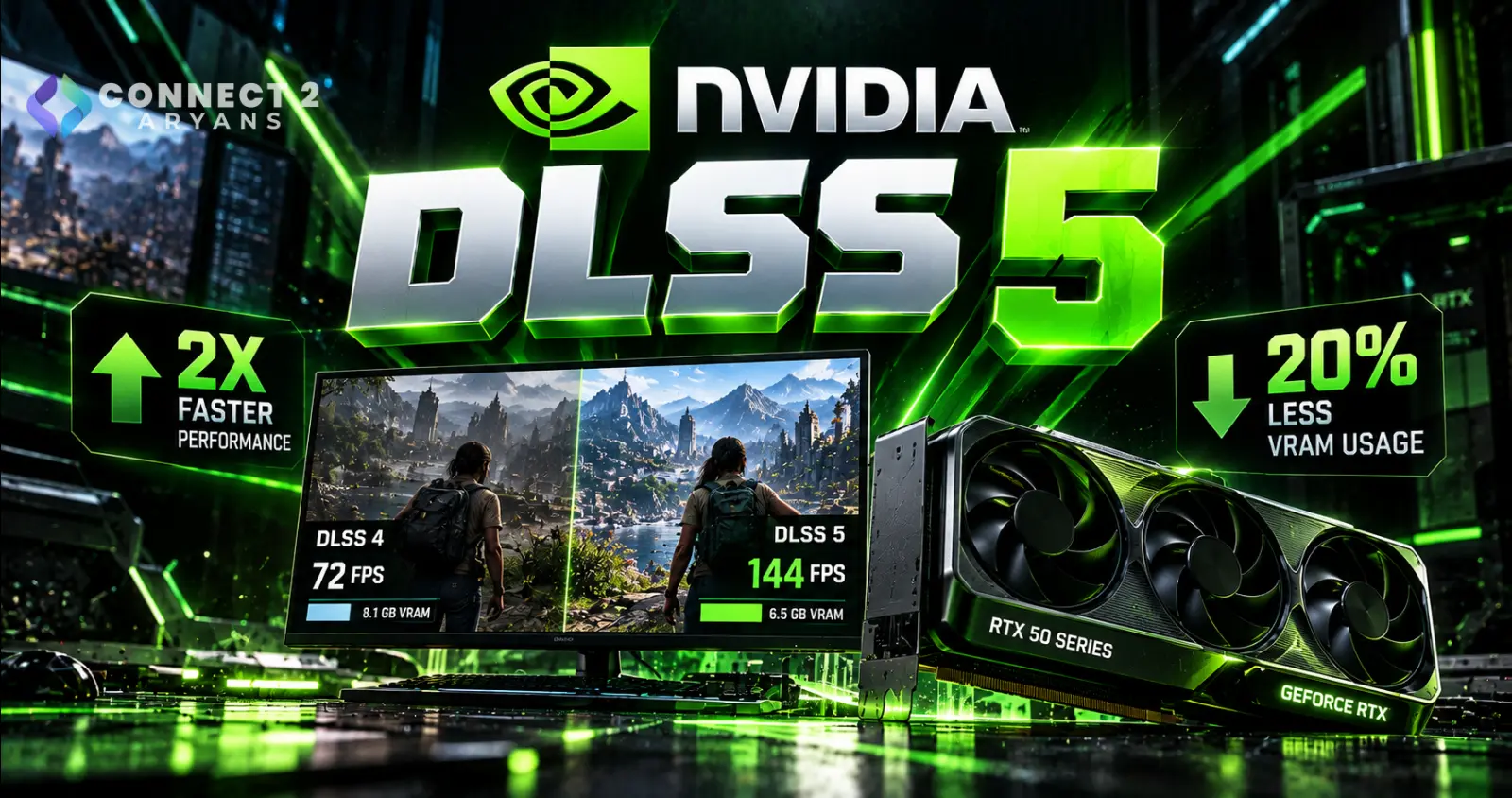
NVIDIA DLSS 5 Gets 2X Faster With 20% Less VRAM Usage — RTX 50 Series Gaming Update Explained
NVIDIA DLSS 5 Gets 2X Faster With 20% Less VRAM Usage — RTX 50 Series Gaming Update Explained
NVIDIA has announced one of its most significant gaming graphics updates of October 2026.
The company has revealed a major improvement to DLSS 5, making its AI-powered 3D-Guided Neural Rendering model twice as fast while reducing memory consumption.
According to NVIDIA's official announcement on October 13, the updated model delivers three major improvements:
2X faster neural-rendering performance
20% lower VRAM usage at 4K resolution
24% smaller AI model
NVIDIA has also introduced a new Frame Generation Performance Mode that can deliver up to 35% higher performance on the GeForce RTX 5060 in its testing.
The announcement is particularly important because DLSS 5's advanced neural-rendering technology previously introduced substantial GPU overhead.
The latest improvements aim to make the technology more practical for gaming on GeForce RTX hardware.
What Is NVIDIA DLSS 5?
NVIDIA DLSS stands for Deep Learning Super Sampling.
Over several generations, DLSS has evolved from an AI-powered upscaling technology into a broader collection of rendering and performance-enhancement features.
These technologies include Super Resolution, Frame Generation, Multi Frame Generation and Ray Reconstruction.
DLSS 5 introduces another major development: 3D-Guided Neural Rendering.
Rather than simply reconstructing a higher-resolution image, the technology uses artificial intelligence to enhance lighting and material appearance within a game.
It operates using information from the game engine, including rendered geometry, textures and lighting data.
The goal is to create more realistic-looking materials and lighting while maintaining the structure of the original game scene.
For example, neural rendering can influence how light interacts with skin, clothing, hair and environmental surfaces.
However, this additional processing requires GPU resources.
That is why NVIDIA's latest performance improvements are significant.
DLSS 5 Is Now Twice as Fast
The biggest announcement concerns the speed of the neural-rendering model.
NVIDIA says its October 2026 update makes the model twice as fast as the September version.
This improvement comes from changes to the rendering pipeline and refinements to the AI model itself.
The company also claims the updated technology is now approximately ten times faster than the version demonstrated when DLSS 5 was first announced in March 2026.
Importantly, this does not mean every game will suddenly deliver twice as many frames per second.
The 2X figure refers to the neural-rendering model's processing performance, not overall game FPS.
Actual gaming improvements depend on how heavily DLSS 5 affects performance in a particular title.
NVIDIA says the updated model can increase frame rates by up to 1.4X in NBA 2K27 compared with the previous implementation.
DLSS 5 Now Uses 20% Less VRAM at 4K
The second major improvement concerns graphics memory.
NVIDIA says the updated neural-rendering model reduces VRAM consumption by approximately 20% at 4K resolution.
This matters because modern games can place considerable demands on GPU memory.
High-resolution textures, ray tracing, rendering buffers and other graphics resources all consume VRAM.
Adding AI-based rendering can increase those requirements further.
Reducing the memory overhead of DLSS 5 therefore makes the technology more efficient.
Does This Mean Every Game Uses 20% Less VRAM?
No.
The reported 20% reduction concerns the memory usage associated with the updated DLSS 5 neural-rendering technology.
It does not mean that a game previously consuming 12GB of total VRAM will automatically drop to 9.6GB.
Overall memory consumption depends on the game, resolution, graphics settings and other rendering features.
Nevertheless, reducing the memory requirements of advanced rendering technology is beneficial, particularly on graphics cards with more limited VRAM capacity.
NVIDIA Has Reduced the AI Model Size by 24%
NVIDIA has also made the DLSS 5 model smaller.
The updated model contains approximately 118 million parameters, representing a 24% reduction compared with the previous version.
A smaller model can require fewer computational resources.
Combined with rendering-pipeline optimizations, this allows NVIDIA to reduce GPU overhead while maintaining comparable visual quality.
According to the company, the October model cuts neural-rendering GPU overhead approximately in half compared with the September implementation.
This is an important development because advanced AI graphics features need to balance visual quality against performance.
A feature that substantially improves image quality but dramatically reduces frame rates may not appeal to every gamer.
Making that feature more efficient increases its practical usefulness.
DLSS 5 October 2026: Old vs New
Here is a comparison of NVIDIA's announced improvements.
| Feature | September 2026 Model | October 2026 Model |
|---|---|---|
| Neural-rendering speed | Baseline | 2X faster |
| AI model size | Previous model | 24% smaller |
| Model parameters | Approximately 155 million | Approximately 118 million |
| VRAM usage at 4K | Baseline | 20% lower |
| GPU overhead | Baseline | Approximately 50% lower |
| Visual quality | Original implementation | NVIDIA claims comparable quality |
These are NVIDIA's reported improvements to the technology itself.
Independent testing across multiple games and graphics cards will be necessary to determine how consistently they translate into better real-world gaming performance.
RTX 5060 Gets a New Frame Generation Performance Mode
NVIDIA's announcement also introduces a separate improvement to Frame Generation.
The company has released a beta version of a new Performance Mode, identified as Preset C.
This mode uses a lighter algorithm to reduce the processing overhead associated with Frame Generation.
NVIDIA says the new preset can deliver up to 35% higher Frame Generation performance on the RTX 5060.
However, this is not a universal 35% FPS increase across all games.
Results depend on the game, GPU and rendering configuration.
NVIDIA also acknowledges that the faster preset involves minor image-quality trade-offs.
The important distinction is that this Frame Generation improvement is separate from the 2X acceleration of DLSS 5 neural rendering.
Which NVIDIA Graphics Cards Support the New Frame Generation Mode?
The new Frame Generation Performance Mode is available through the NVIDIA app beta for supported hardware.
NVIDIA identifies the following GPU families:
GeForce RTX 40 Series
GeForce RTX 50 Series
RTX Spark laptops
Support for individual Frame Generation technologies still depends on the GPU generation and game.
For example, standard Frame Generation and Multi Frame Generation do not have identical hardware requirements.
The new preset does not remove those underlying compatibility restrictions.
It improves the performance of supported Frame Generation features.
How to Enable NVIDIA's New Frame Generation Performance Mode
NVIDIA has provided instructions for accessing Preset C through its beta software.
Step 1: Update the NVIDIA App
Install the latest NVIDIA app.
Step 2: Enable Beta Features
Open the app's settings and navigate to the About section.
Enable the option for beta or experimental features.
Step 3: Install the Beta Update
Allow the NVIDIA app to download and install the available beta version.
Step 4: Open Graphics Settings
Navigate to the Graphics section.
Select a supported game or choose Global Settings.
Step 5: Find DLSS Override Settings
Locate the DLSS Override model-preset controls.
Step 6: Select Preset C
Choose the custom Frame Generation preset and select Preset C.
Apply the changes.
The option will only provide an effect where the hardware, game and selected Frame Generation feature support it.
Because this is a beta feature, users should also be aware that software behavior may change before the final release.
DLSS 5 Update Arrives in NBA 2K27 on October 16
The improved neural-rendering model is scheduled to debut in NBA 2K27 on October 16, 2026.
NVIDIA says the new model can improve the game's frame rates by up to 1.4X compared with the previous version.
This makes NBA 2K27 an important early example of how much the optimized DLSS 5 model can improve real gaming performance.
However, the figure comes from NVIDIA's testing.
Performance may differ across graphics cards, resolutions and settings.
The updated model is also expected to become the default implementation for future DLSS 5-supported games.
Hogwarts Legacy Is Getting DLSS 5 on November 5
Another important announcement concerns Hogwarts Legacy.
NVIDIA has confirmed that the game will receive DLSS 5 with 3D-Guided Neural Rendering on November 5, 2026.
The update will introduce AI-enhanced lighting and materials.
NVIDIA has also explained that the game's developer has adjusted the implementation to preserve the intended visual appearance.
This matters because early DLSS 5 demonstrations attracted criticism for changing the appearance of certain characters.
The upcoming Hogwarts Legacy implementation appears designed to address those concerns through more carefully controlled rendering effects.
Why Artistic Control Matters
AI-based rendering introduces an important challenge.
A game developer may intentionally design characters, environments and lighting around a particular artistic style.
If an AI rendering system changes those elements too aggressively, the final image may look different from what the artists intended.
NVIDIA says developers can control how DLSS 5 affects different objects and materials.
That includes the ability to restrict or exclude specific elements from neural-rendering modifications.
The success of this approach will depend on how individual developers implement the technology.
DLSS 5 Is Also Coming to Where Winds Meet
NVIDIA has confirmed that Where Winds Meet will receive DLSS 5 support later in 2026.
The update will use the improved neural-rendering model.
As with Hogwarts Legacy, the technology is intended to enhance lighting and material appearance.
Specific real-world performance improvements will need to be measured once the update becomes available.
RTX Remix Will Receive DLSS 5 on October 23
NVIDIA is also expanding DLSS 5 into its RTX Remix platform.
The update is scheduled for October 23, 2026.
RTX Remix allows modders to enhance older PC games using modern graphics technologies.
These can include path tracing, improved materials and AI-assisted rendering.
Adding DLSS 5 gives modders another tool for improving the visual appearance of classic games.
NVIDIA has demonstrated the technology in community projects involving titles such as Fallout 4 and Mirror's Edge.
However, these demonstrations should not be confused with official game remasters or confirmed releases of the individual projects.
What Does This Mean for RTX 50-Series Owners?
For owners of modern GeForce RTX 50-series graphics cards, the update is particularly relevant.
The new DLSS 5 model reduces the overhead associated with advanced neural rendering.
That could make the feature more practical across supported RTX 50-series GPUs.
RTX 5060
The RTX 5060 is particularly interesting because NVIDIA specifically demonstrated improvements from the new Frame Generation Performance Mode on this GPU.
The company reports up to 35% higher performance for the Frame Generation feature in its testing.
However, results will depend on the game.
RTX 5070
RTX 5070 owners may benefit from the improved efficiency of DLSS 5 in supported games.
Reduced neural-rendering overhead could help preserve more performance when advanced AI visual effects are enabled.
Specific frame-rate improvements have not been established across all supported games.
RTX 5080
The RTX 5080 provides greater graphics-processing resources than lower-tier RTX 50-series models.
Its owners may be interested in combining high-resolution gaming with advanced rendering features.
The updated DLSS 5 model could reduce the performance cost of enabling neural rendering.
RTX 5090
Even high-end graphics cards can experience substantial performance overhead from advanced rendering technologies.
Reducing that overhead can be valuable when gaming at high resolutions with demanding visual settings.
However, NVIDIA's announcement does not establish a universal performance improvement for every RTX 5090 game.
Does DLSS 5 Make an RTX 5060 as Fast as an RTX 5070?
No.
Software improvements do not eliminate the hardware differences between graphics cards.
The RTX 5060 and RTX 5070 have different GPU resources and performance capabilities.
DLSS can improve the gaming experience in supported titles, but it does not physically increase CUDA core counts, memory capacity or memory-bus width.
Frame Generation also needs to be understood correctly.
Generated frames can increase displayed frame rates, but they do not provide the same benefits as increasing the game's underlying rendered frame rate.
Responsiveness, latency and image quality remain important considerations.
Therefore, buyers should continue comparing graphics cards using independent gaming benchmarks rather than relying only on advertised Frame Generation figures.
Will DLSS 5 Improve Every Game?
No.
DLSS 5 neural rendering requires game-specific support.
A game that supports DLSS Super Resolution does not automatically support DLSS 5's 3D-Guided Neural Rendering.
Similarly, the new Frame Generation Performance Mode applies only where the relevant technology is supported.
Users should check each game's supported DLSS features rather than assuming all RTX-enhanced games receive the same improvements.
Why Lower VRAM Usage Is Important for Modern Gaming
Graphics memory has become an increasingly important part of GPU selection.
Modern games can use substantial VRAM, especially when running at higher resolutions with demanding texture and ray-tracing settings.
However, memory capacity is only one aspect of graphics-card performance.
GPU architecture, processing power, memory bandwidth and software optimization also matter.
NVIDIA's latest DLSS 5 update demonstrates that software efficiency can help reduce the memory overhead of advanced rendering features.
That is beneficial, but it does not replace the need for sufficient physical VRAM.
A graphics card with limited memory capacity can still encounter problems if a game's overall memory requirements exceed what is available.
What Does This Mean for Gaming PC Buyers in Pakistan?
For Pakistani gamers considering a new graphics card, NVIDIA's announcement adds another factor to the buying decision.
Modern graphics cards should be evaluated based on both hardware capabilities and supported software features.
However, the new DLSS 5 improvements do not automatically make one GPU the best choice for every buyer.
Before purchasing, consider your monitor resolution, preferred games, graphics settings and budget.
Choosing a GPU for 1080p Gaming
At 1080p, overall GPU performance and the game's optimization are important.
Frame Generation can be useful in supported games, but a good underlying frame rate remains desirable.
Choosing a GPU for 1440p Gaming
At 1440p, graphics-processing power and memory requirements generally become more demanding.
DLSS technologies can help improve performance in supported titles.
Choosing a GPU for 4K Gaming
At 4K, GPU processing power and memory bandwidth become particularly important.
The updated DLSS 5 model's reduced VRAM overhead is relevant here, although it should not be confused with a 20% reduction in total game memory requirements.
Explore NVIDIA Graphics Cards
Browse the latest NVIDIA GeForce RTX and AMD Radeon graphics cards at Connect2Aryans to compare available GPU options for your gaming PC.
Is DLSS 5 Better Than Traditional DLSS Upscaling?
DLSS 5 neural rendering and conventional DLSS Super Resolution perform different functions.
DLSS Super Resolution reconstructs a higher-resolution image from a lower-resolution render.
DLSS 5's 3D-Guided Neural Rendering focuses on enhancing lighting and material appearance.
Frame Generation creates additional displayed frames.
These technologies can complement one another, but they should not be treated as interchangeable.
A game may support one DLSS feature without supporting every other feature.
The best combination depends on the game, GPU and player's priorities.
What Are the Downsides of AI Neural Rendering?
Despite the improvements, DLSS 5 still presents several considerations.
Additional GPU Processing
Neural rendering requires computational resources.
The October update reduces that overhead but does not eliminate it.
Visual Differences
AI-enhanced rendering can alter how surfaces, lighting and characters appear.
Some players may prefer the original presentation.
Game Compatibility
DLSS 5 requires supported game integrations.
Hardware Requirements
Advanced DLSS features have specific GPU compatibility requirements.
Performance Variations
A performance improvement demonstrated in one game does not guarantee the same result in another.
These limitations are important when evaluating the technology.
What Happens Next for NVIDIA DLSS 5?
NVIDIA has confirmed several upcoming milestones.
| Date | Update |
|---|---|
| October 13, 2026 | Faster DLSS 5 model announced |
| October 13, 2026 | New Frame Generation Performance Mode beta announced |
| October 16, 2026 | Updated DLSS 5 model arrives in NBA 2K27 |
| October 16, 2026 | DLSS 5 support expands to RTX Spark laptops |
| October 23, 2026 | DLSS 5 arrives in RTX Remix |
| November 5, 2026 | Hogwarts Legacy receives DLSS 5 |
| Later in 2026 | Where Winds Meet receives DLSS 5 |
These dates come from NVIDIA's official October announcement.
Frequently Asked Questions
What is new in the October 2026 NVIDIA DLSS 5 update?
NVIDIA has announced a neural-rendering model that runs twice as fast, uses 20% less VRAM at 4K and is 24% smaller than the previous version.
Does DLSS 5 double gaming FPS?
No. The 2X improvement refers to the neural-rendering model's processing speed, not total gaming frame rates.
Does DLSS 5 use less VRAM now?
Yes. NVIDIA reports a 20% reduction in the neural-rendering model's VRAM usage at 4K.
Does the RTX 5060 get better Frame Generation performance?
NVIDIA reports up to 35% higher Frame Generation performance on the RTX 5060 using the new Preset C mode in its testing.
Does RTX 40 Series support the new update?
The new Frame Generation Performance Mode supports compatible RTX 40-series GPUs. DLSS 5 neural-rendering support and Frame Generation support are separate features with different compatibility requirements.
When will Hogwarts Legacy get DLSS 5?
NVIDIA has confirmed November 5, 2026.
When does the faster DLSS 5 model launch?
The updated neural-rendering model is scheduled to debut in NBA 2K27 on October 16, 2026.
Is DLSS 5 available in every game?
No. DLSS 5 neural rendering requires specific game support.
Is the new Frame Generation Performance Mode available now?
NVIDIA announced the beta mode on October 13, 2026. Compatible users can access it through the NVIDIA app beta.
Conclusion
NVIDIA's October 2026 DLSS 5 announcement demonstrates how quickly AI-powered graphics technology is evolving.
The company has managed to make its 3D-Guided Neural Rendering model twice as fast while reducing VRAM usage by 20% at 4K.
It has also reduced the model's size by 24%, bringing it down to approximately 118 million parameters.
Alongside those improvements, NVIDIA has introduced a new Frame Generation Performance Mode capable of delivering up to 35% higher performance on the RTX 5060 in its testing.
These developments are significant because advanced AI graphics features can place additional demands on GPU resources.
Reducing that overhead makes the technology more practical for supported gaming hardware.
However, the distinction between neural-rendering speed, Frame Generation performance and actual game FPS remains important.
A 2X faster AI model does not automatically mean twice the gaming performance.
The upcoming updates to NBA 2K27, Hogwarts Legacy and RTX Remix will provide opportunities to evaluate how the improvements perform in real games.
For PC gamers, the broader message is clear:
Modern graphics-card performance increasingly depends on both hardware and software optimization.
A powerful GPU remains essential, but technologies such as DLSS are becoming an increasingly important part of the gaming experience.
For gamers in Pakistan planning a new build or graphics-card upgrade, choosing the right GPU still requires considering actual gaming performance, memory capacity, resolution and budget.
Explore the latest NVIDIA GeForce RTX graphics cards and other gaming PC components at Connect2Aryans.