
RAM Prices Have Reversed 20 Years of Progress: AI Memory Shortage Pushes Costs Back to 2007 Levels
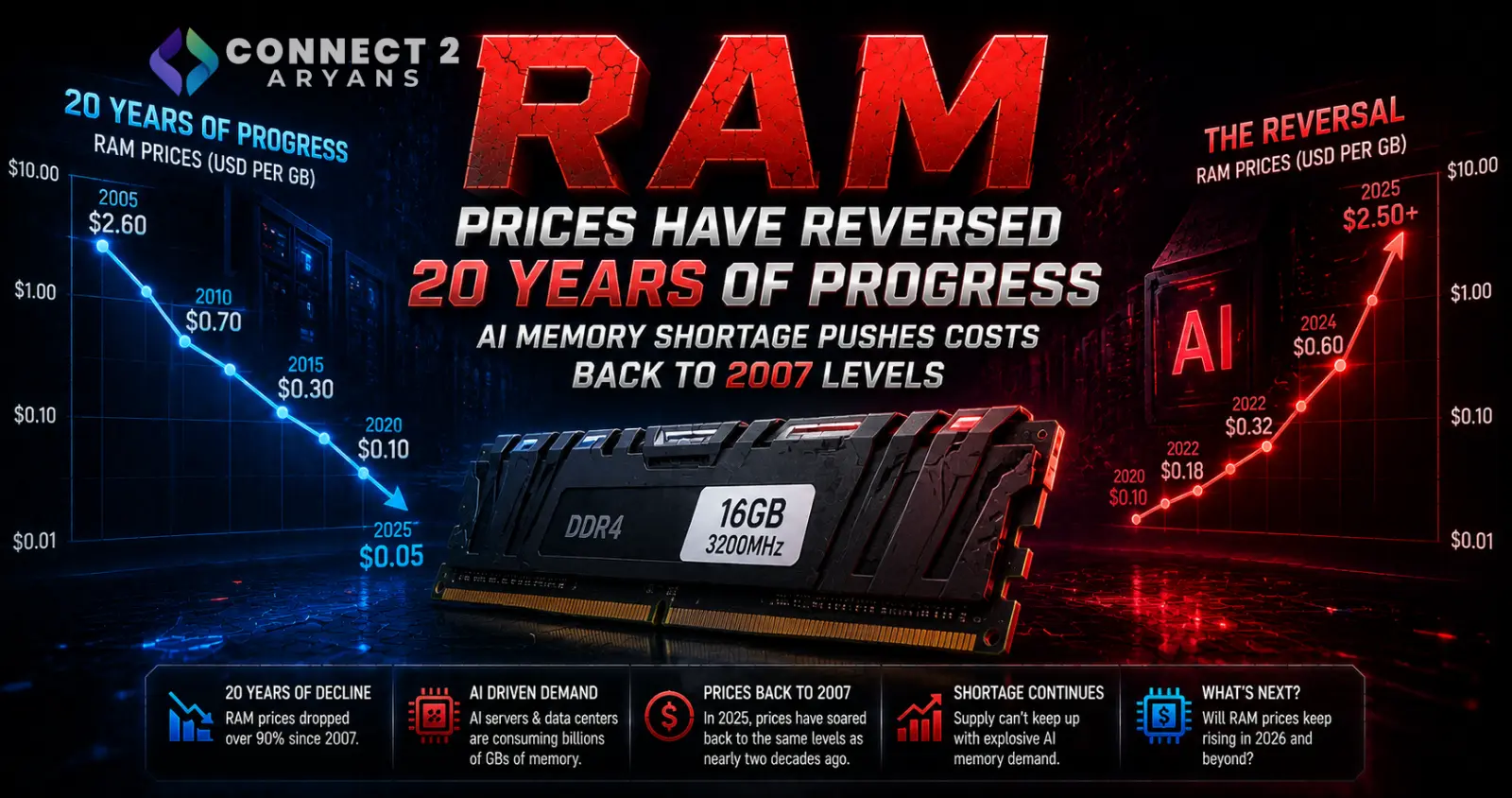
RAM Prices Have Reversed 20 Years of Progress: AI Memory Shortage Pushes Costs Back to 2007 Levels
For decades, one trend in PC hardware seemed almost guaranteed: memory would become cheaper over time.
Manufacturing improved, DRAM density increased, and consumers could generally buy more RAM for less money with each new generation.
In 2026, that trend has been turned on its head.
A new analysis highlighted by Tom's Hardware on August 8 suggests that, after adjusting for inflation, RAM pricing has effectively returned to levels last seen around 2007. In other words, the current memory crisis has undone roughly two decades of normalized price progress in only a matter of months.
The biggest force behind the disruption is the enormous demand for memory created by the AI infrastructure boom.
And for anyone planning a gaming PC, workstation or RAM upgrade in Pakistan, this isn't just an interesting industry statistic—it could directly affect how much your next PC costs.
What Happened to RAM Prices in 2026?
RAM prices normally follow a long-term downward trend.
As semiconductor manufacturing improves, manufacturers can produce greater memory capacity more efficiently. Over time, this has allowed PC builders to move from megabytes to gigabytes—and eventually to 16GB, 32GB and larger configurations—without memory consuming an ever-growing share of the PC budget.
The current market has disrupted that pattern.
According to the new analysis reported by Tom's Hardware, normalized RAM pricing has climbed back toward 2007-era levels, with the AI-driven shortage reversing years of declining memory costs.
This isn't simply the usual small fluctuation between one quarter and another.
The broader DRAM market has experienced unusually severe price pressure throughout 2026.
AI Is Reshaping the Memory Market
The biggest reason is artificial intelligence.
Massive AI data centers require enormous amounts of memory, particularly high-performance server memory and advanced products used alongside AI accelerators.
Memory manufacturers have therefore faced extremely strong demand from:
- AI data centers
- Cloud service providers
- Enterprise servers
- AI accelerator systems
- Large technology companies
That matters to ordinary PC buyers because semiconductor manufacturing capacity is limited.
When suppliers prioritize rapidly growing and highly profitable AI and server markets, the consumer memory market can face tighter supply.
TrendForce reported in July that AI server demand was continuing to support memory pricing in Q3 2026, while describing the DRAM market as extremely tight.
This Memory Crisis Didn't Start Overnight
The warning signs appeared much earlier in 2026.
TrendForce dramatically increased its memory-price outlook for the first quarter, forecasting conventional DRAM contract prices to rise 90–95% quarter-over-quarter.
The pressure continued into the second quarter.
Its March forecast projected another 58–63% quarter-over-quarter increase in conventional DRAM contract prices, driven partly by cloud service providers securing supply through long-term agreements as AI-server demand continued to grow.
By the third quarter, the rate of increase was expected to moderate, but the underlying memory market remained tight.
That sequence helps explain why the latest 2007 comparison is so striking.
This isn't the result of one sudden retail price increase. It's the cumulative effect of months of extraordinary pressure throughout the memory supply chain.
DDR4 Isn't Automatically the Cheap Escape
PC builders might assume that older DDR4 memory should be immune from the problem.
Unfortunately, the situation is more complicated.
TrendForce reported in June that shortages had spread across consumer DRAM, including mature products, as structural supply tightening affected older memory technologies as well.
That means simply choosing an older DDR4 platform doesn't guarantee that memory pricing will remain unaffected.
This is especially important for budget PC builders.
Historically, DDR4 has been one of the easiest ways to reduce the cost of a gaming or office PC. But when supply becomes constrained across multiple DRAM generations, the savings can become less predictable.
What Does This Mean for DDR5 Gaming PCs?
DDR5 is now the primary memory platform for many current-generation desktop systems.
Modern AM5 motherboards, for example, use DDR5 memory.
Connect2Aryans currently lists DDR5-based AM5 boards such as the MSI PRO B840M-B AM5 DDR5 Motherboard
The same applies to newer Intel platforms. Connect2Aryans Intel Core Ultra 7 265KF listing identifies DDR5 support on the LGA1851 platform:
This makes memory pricing increasingly important when calculating the total cost of a new-generation PC.
A CPU or motherboard may look attractively priced on its own, but the complete platform cost also includes compatible RAM.
DDR4 Platforms Could Still Matter for Budget Builders
Older platforms haven't disappeared.
Some Intel LGA1700 processors support both DDR4 and DDR5 depending on the motherboard used.
For example, Connect2Aryans lists the Intel Core i7-14700KF with support for both DDR4 and DDR5 memory
A DDR4 motherboard such as the MSI PRO B760M-E DDR4 can therefore still offer an alternative platform for compatible processors:
But with DDR4 itself experiencing supply pressure, buyers should compare the complete platform price rather than assuming the older memory generation will always provide the better deal.
Why RAM Prices Matter Beyond RAM
Higher memory prices don't only affect people upgrading from 16GB to 32GB.
They can increase the total cost of:
- Gaming PCs
- Workstations
- Laptops
- Prebuilt desktops
- Servers
- Mini PCs
- Professional systems
RAM is an essential component.
A new PC cannot simply remove memory from the budget when prices rise.
Manufacturers and system builders therefore have three basic options:
Absorb the additional cost, increase system prices, or reduce specifications elsewhere.
This is why prolonged DRAM inflation can eventually influence the wider PC market.
What Could This Mean for Pakistan?
Pakistan is particularly sensitive to international hardware-price movements because most PC components are imported.
Local pricing can additionally be influenced by:
- Currency exchange rates
- Distributor costs
- Shipping
- Import expenses
- Existing local inventory
- Replacement stock costs
That doesn't mean an international DRAM contract-price increase translates directly into an identical percentage increase at Pakistani retailers.
Retail inventory moves through several layers before reaching consumers.
However, if replacement stock continues arriving at higher costs, sustained global memory inflation can eventually influence local RAM and complete-PC pricing.
For Pakistani buyers, the key point is therefore not to assume today's RAM price will necessarily remain available several months from now.
Should You Buy RAM Now?
Don't panic-buy memory simply because prices are rising.
But if you're already planning a PC build or RAM upgrade, waiting indefinitely for a major price collapse may carry more risk than it did during a normal memory cycle.
Consider buying sooner if:
- You're already building a new PC
- Your current RAM capacity is limiting your workload
- You've already chosen your CPU and motherboard
- You find the exact memory kit you need at an acceptable price
Waiting can still make sense if:
- You don't actually need an upgrade
- Your existing PC performs well
- You're waiting for an entirely new platform
- Current pricing exceeds your budget
The important distinction is between buying because you need the hardware and buying purely because you're afraid prices might increase.
Don't Sacrifice the Rest of Your PC for More RAM
Another mistake is overreacting to the shortage by buying excessive memory.
A gaming PC doesn't automatically become faster simply because it contains 64GB instead of 32GB.
If the additional capacity isn't required by your games or applications, that money may provide greater benefit elsewhere in the system.
When building a PC during an expensive memory cycle, balance becomes even more important.
Consider the entire platform:
CPU + Motherboard + RAM + GPU + Storage + PSU + Cooling
rather than optimizing one component in isolation.
You can compare current motherboard platforms through the
https://www.connect2aryans.com/motherboard-price-in-pakistan
Could RAM Prices Come Back Down?
Eventually, increased manufacturing capacity can help improve supply.
Memory manufacturers are already investing heavily.
For example, Nanya Technology recently unveiled plans involving up to US$10.7 billion of investment through 2029 for its Fab 5A project and next-generation DRAM manufacturing.
But semiconductor fabs take significant time to build, equip and ramp into volume production.
That means large long-term investments don't necessarily solve a consumer shortage immediately.
For the remainder of 2026, AI-server demand remains an important factor influencing the memory market.
FAQs
Why are RAM prices increasing in 2026?
One major factor is extremely strong memory demand from AI servers and cloud infrastructure. Tight DRAM supply and manufacturers' allocation decisions have contributed to substantial contract-price increases throughout 2026.
Are RAM prices really back to 2007 levels?
The new analysis refers to normalized/inflation-adjusted pricing, not the sticker price of a specific RAM kit. It suggests the recent shortage has pushed normalized memory costs back toward levels last seen around 2007.
Is DDR4 also becoming more expensive?
DDR4 and other mature DRAM products have also faced supply tightening. TrendForce reported shortages extending through consumer DRAM markets during 2026.
Is DDR5 affected by the AI memory shortage?
The broader DRAM market has been affected by tight supply and strong AI/server demand. The exact impact varies by memory type, contract and market segment.
Should I buy RAM now or wait?
If you're already building or upgrading a PC and find the capacity and specification you need at an acceptable price, buying now can reduce exposure to further increases. If you don't actually need an upgrade, there's no reason to panic-buy.
Conclusion
The latest RAM-price analysis highlights just how unusual the 2026 memory market has become.
For decades, PC builders could generally rely on memory becoming cheaper as manufacturing technology improved. The AI infrastructure boom has disrupted that pattern so dramatically that inflation-adjusted RAM pricing is now being compared with 2007 levels, effectively reversing around 20 years of progress in only months.
And the underlying pressure is real: TrendForce has repeatedly documented major DRAM contract-price increases and tight supply throughout 2026, with AI-server demand remaining an important driver.
For PC builders in Pakistan, this doesn't mean rushing out and buying unnecessary RAM. It means paying closer attention to complete platform costs, memory compatibility and upgrade timing when planning a new system.
https://www.connect2aryans.com/motherboard-price-in-pakistan
Browse PC components for your next gaming or professional build on Connect2Aryans, with warranty support included.