
NVIDIA RTX Spark Laptop Chip Appears on Geekbench: 20-Core Arm CPU Shows Serious Performance
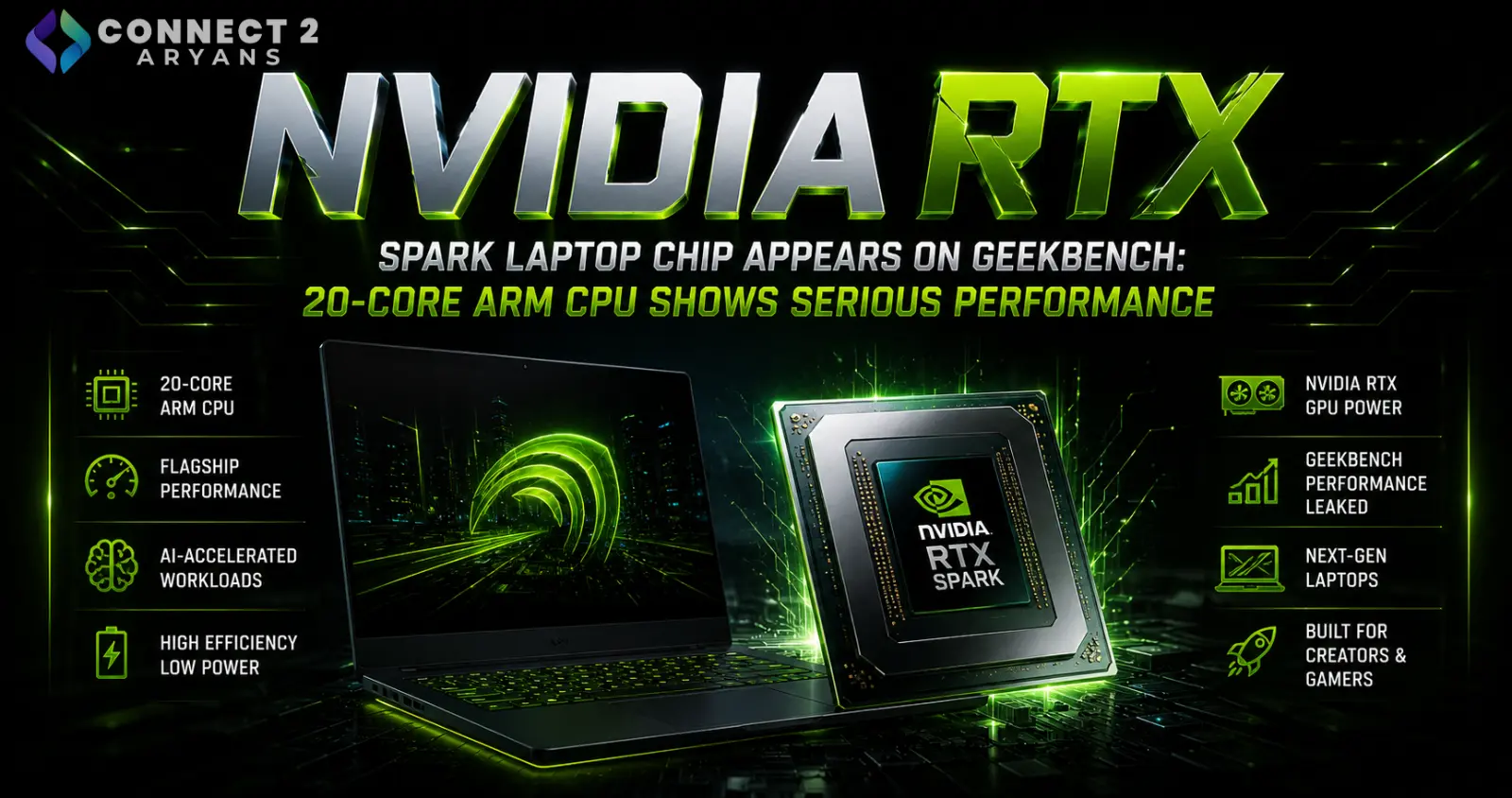
NVIDIA RTX Spark Laptop Chip Appears on Geekbench: 20-Core Arm CPU Shows Serious Performance
NVIDIA's long-awaited move into high-performance Windows laptop processors is becoming much more interesting.
Two configurations of the upcoming NVIDIA RTX Spark platform have appeared in the Geekbench 7 database, revealing both 20-core and 18-core CPU configurations and giving us an early indication of how NVIDIA's Arm-based laptop platform could perform.
The full 20-core version reportedly achieved:
2,570 points in Geekbench 7 single-core
and
23,126 points in Geekbench 7 multi-core
while a newly discovered 18-core configuration scored 2,541 single-core and 21,776 multi-core.
Those are impressive early numbers—particularly in multi-core performance.
But these are still pre-release engineering samples, and NVIDIA has not confirmed final retail specifications, pricing or availability for these exact configurations.
So what exactly is RTX Spark, and why is NVIDIA suddenly becoming such an important competitor in the laptop CPU market?
What Is NVIDIA RTX Spark?
RTX Spark is an upcoming NVIDIA computing platform that combines an Arm-based CPU with powerful integrated NVIDIA graphics.
Rather than simply supplying the discrete GPU inside a laptop—as NVIDIA has traditionally done—the company is moving toward providing much more of the computer's core processing platform itself.
That potentially puts NVIDIA into much more direct competition with:
- Intel
- AMD
- Qualcomm
- Apple
The newly leaked Geekbench results provide one of our clearest looks yet at the CPU side of the platform.
Two RTX Spark Variants Have Now Appeared
The most interesting part of the latest leak is that RTX Spark apparently isn't limited to a single configuration.
Geekbench listings have revealed at least two versions.
Full 20-Core RTX Spark
The higher-end configuration reportedly uses a:
10 + 10 CPU-core configuration
alongside a GPU containing 6,144 CUDA cores.
Cut-Down 18-Core RTX Spark
The second configuration uses:
10 + 8 CPU cores
for 18 total CPU cores.
Its GPU is also reduced to 5,120 CUDA cores.
This strongly suggests NVIDIA could be preparing multiple RTX Spark tiers rather than one single laptop processor.
RTX Spark 20-Core Geekbench Results
The full 20-core engineering sample produced the following Geekbench 7 scores:
| Test | RTX Spark 20-Core |
|---|---|
| Single-Core | 2,570 |
| Multi-Core | 23,126 |
The 18-core version produced:
| Test | RTX Spark 18-Core |
| Single-Core | 2,541 |
| Multi-Core | 21,776 |
That means removing two CPU cores resulted in only around a 6% reduction in multi-core performance, while single-core performance remained extremely close.
For a potentially lower-tier version of the platform, that's an interesting result.
Why the 18-Core Version Matters
A cut-down processor can sometimes tell us more about a product strategy than the flagship.
The existence of an 18-core configuration suggests NVIDIA may be planning to segment RTX Spark across multiple laptop performance levels.
Instead of selling one expensive flagship chip, NVIDIA could potentially offer different combinations of CPU and GPU resources.
For example:
Higher-tier RTX Spark → more CPU cores + larger GPU
Lower-tier RTX Spark → fewer CPU cores + smaller GPU
That would be similar to how Intel, AMD and Apple create multiple products from related processor architectures.
However, NVIDIA has not announced final retail SKUs corresponding to these engineering samples, so exact product positioning remains unconfirmed.
NVIDIA's Multi-Core Performance Looks Particularly Strong
The leaked multi-core result is arguably the biggest story.
Tom's Hardware's comparison of the Geekbench results places the 20-core RTX Spark ahead of several powerful x86 laptop processors in this particular benchmark, including AMD's Ryzen AI Max+ 395 and Intel's Core Ultra 9 275HX.
VideoCardz similarly reports the RTX Spark N1X ahead of the Ryzen AI Max+ 395 in the leaked Geekbench 7 multi-core results.
That does not mean RTX Spark is automatically faster than those processors overall.
Geekbench measures only certain CPU workloads.
Real laptops need to be tested across:
- Gaming
- Rendering
- Encoding
- Productivity
- Compilation
- AI workloads
- Battery life
- Sustained performance
- Thermals
Still, seeing NVIDIA competitive this early is noteworthy.
Single-Core Performance Is Less Dominant
The situation changes when looking at single-core performance.
The 20-core RTX Spark scored 2,570 points.
That is strong, but Apple and Qualcomm remain highly competitive in this area.
Tom's Hardware notes that Apple's M4 Pro reached 3,315 in the comparison, around 29% ahead of the RTX Spark result, while Qualcomm's Snapdragon X2 Elite also performed strongly.
This highlights something important:
RTX Spark isn't simply dominating every CPU benchmark.
Its biggest early strength appears to be multi-core performance.
NVIDIA Is Using Arm, Not x86
Perhaps the biggest change isn't the benchmark score.
It's the architecture.
Most gaming laptops have historically been built around x86 processors from Intel or AMD.
NVIDIA's upcoming laptop processor instead uses Arm CPU technology.
That puts NVIDIA closer conceptually to platforms such as:
Apple Silicon
and
Qualcomm Snapdragon X
than a conventional Intel Core or AMD Ryzen laptop processor.
Arm-based Windows PCs have improved substantially in recent years, but software compatibility remains an important consideration.
Why NVIDIA Wants Its Own Laptop CPU
NVIDIA already dominates a large portion of the discrete gaming GPU market.
A traditional gaming laptop might contain:
Intel CPU + NVIDIA GPU
or
AMD CPU + NVIDIA GPU
NVIDIA supplies only one major part of that platform.
RTX Spark changes the equation.
NVIDIA could potentially control:
CPU + GPU + AI acceleration + memory architecture + software stack
within a much more tightly integrated platform.
That gives NVIDIA considerably more control over performance and efficiency.
Apple Has Already Proven This Model Can Work
Apple's transition away from Intel demonstrates what tightly integrated processor platforms can achieve.
Apple controls:
- CPU architecture
- GPU architecture
- Neural processing
- Memory design
- Operating-system optimization
That allows the company to optimize the complete platform rather than treating every component independently.
NVIDIA appears to be pursuing some of the same advantages for Windows PCs—but with its own graphics technology playing a central role.
The GPU Side Could Be Even More Important Than the CPU
RTX Spark isn't interesting only because it contains 20 CPU cores.
The higher configuration reportedly includes 6,144 CUDA cores, while the cut-down version contains 5,120 CUDA cores.
That's a substantial amount of integrated GPU hardware.
It potentially gives NVIDIA an opportunity to build laptops that don't follow the traditional:
CPU + separate discrete GPU
design.
Instead, significant CPU and GPU resources could exist inside one highly integrated platform.
Why Integrated NVIDIA Graphics Could Be a Big Deal
Integrated graphics traditionally meant accepting substantially lower performance than a dedicated gaming GPU.
That gap has been narrowing.
AMD has demonstrated this particularly well with powerful Ryzen APUs and Ryzen AI Max products.
NVIDIA entering the same space is especially interesting because GPUs are the company's core strength.
A powerful integrated NVIDIA GPU could potentially provide:
- Gaming acceleration
- CUDA support
- AI acceleration
- Video processing
- Creator application acceleration
without requiring a completely separate mobile graphics processor.
Whether RTX Spark can actually replace high-performance discrete laptop GPUs will depend on real-world testing.
Don't Confuse RTX Spark With a GeForce RTX Laptop GPU
The naming can be confusing.
RTX Spark is not simply another GeForce RTX 50-series Laptop GPU.
It is a broader computing platform combining CPU and GPU resources.
Traditional gaming laptops available today still commonly use processors from Intel or AMD paired with discrete NVIDIA GeForce graphics.
Browse Gaming Laptops on Connect2Aryans
The current Connect2Aryans gaming-laptop collection includes systems using processors such as Intel Core Ultra and Core HX chips alongside GeForce RTX 4050, RTX 5050 and RTX 5060 Laptop GPUs.
RTX Spark represents a potentially different approach.
Current Gaming Laptops Still Use the Traditional CPU + GPU Model
For example, Connect2Aryans currently lists HP Omen systems combining the Intel Core Ultra 7 255H with GeForce RTX 5060 8GB graphics.
Other current gaming laptops pair Intel processors with RTX 5050, RTX 4050 and other dedicated NVIDIA GPUs.
That traditional arrangement has an important advantage:
Manufacturers can mix processors and GPUs according to the performance tier they want.
RTX Spark could allow NVIDIA to integrate far more of the system itself, but we don't yet know how laptop manufacturers will configure final products around the platform.
RTX Spark Could Challenge AMD Ryzen AI Max
AMD is arguably one of the most obvious competitors for this type of NVIDIA processor.
Ryzen AI Max combines powerful Zen CPU cores with unusually capable integrated Radeon graphics and a unified-memory-oriented design.
That makes it suitable for:
- Premium laptops
- Compact workstations
- Mini PCs
- Content creation
- AI workloads
RTX Spark appears to target a similarly high-performance integrated-computing segment.
The leaked Geekbench results suggest NVIDIA's CPU performance could already be competitive with AMD's Ryzen AI Max+ 395 in certain workloads.
The much bigger question will be GPU performance.
Intel Has Another New Competitor
Intel has dominated Windows laptop processors for decades.
But the competitive landscape is becoming increasingly crowded.
Intel now faces:
AMD Ryzen
Qualcomm Snapdragon X
Apple Silicon in the wider premium-laptop market
and potentially:
NVIDIA RTX Spark
NVIDIA entering the Windows CPU market is particularly significant because Intel and NVIDIA already compete and cooperate within gaming laptops.
Today, NVIDIA benefits when manufacturers pair GeForce GPUs with Intel CPUs.
Tomorrow, NVIDIA may also want manufacturers to choose an NVIDIA processor platform instead.
Qualcomm Proved Windows on Arm Can Be Taken Seriously
Another reason RTX Spark is more credible now than an Arm-based Windows gaming platform might have been several years ago is Qualcomm.
Snapdragon X processors helped push Windows on Arm much further into mainstream premium laptops.
Microsoft has also continued improving Windows Arm support and application compatibility.
NVIDIA therefore isn't entering a completely undeveloped ecosystem.
However, gaming creates additional challenges.
Gaming Compatibility Will Be One of the Biggest Questions
Benchmarking the CPU is only the beginning.
For RTX Spark to become important for gaming laptops, games need to work properly.
Windows on Arm can run native Arm applications and translate many x86 applications.
But PC gaming involves more than the game executable.
Compatibility can also depend on:
- Anti-cheat systems
- Launchers
- Drivers
- DRM
- Background utilities
- Modding tools
- Peripheral software
A laptop can have excellent hardware and still provide a poor gaming experience if software compatibility isn't reliable.
This is therefore one of the biggest areas to watch when RTX Spark systems eventually reach reviewers.
NVIDIA Has a Major Software Advantage
NVIDIA does have something most new CPU entrants don't:
an enormous existing PC software ecosystem.
NVIDIA already develops technologies including:
- GeForce drivers
- CUDA
- DLSS
- Reflex
- NVENC
- Broadcast
- AI software
- Creator acceleration
That could make RTX Spark more than simply another Arm processor.
NVIDIA can potentially optimize the platform around software technologies it already controls.
For creators and AI developers, CUDA support could be particularly significant.
RTX Spark Could Be Extremely Interesting for AI Laptops
Gaming may attract the headlines, but AI could be equally important.
NVIDIA is currently the dominant company in AI accelerator hardware.
Bringing CPU, GPU and AI capabilities together inside a laptop platform creates obvious opportunities for local AI workloads.
A powerful integrated GPU combined with substantial unified memory could potentially allow laptops to run larger AI models locally.
That could appeal to:
- Developers
- Researchers
- Content creators
- Engineers
- AI enthusiasts
But final memory configurations and AI performance for consumer RTX Spark laptops remain unconfirmed.
The Geekbench Systems Reportedly Had 64GB Memory
The leaked listings reportedly showed systems configured with 64GB of memory.
That is noteworthy for a high-performance integrated platform.
Large memory capacity can be particularly useful when CPU and GPU resources share access to the same memory pool.
But again, these are engineering systems.
A 64GB test configuration does not guarantee that every retail RTX Spark laptop will ship with 64GB.
Manufacturers could eventually offer several capacities.
Could RTX Spark Reduce the Need for Dedicated Laptop GPUs?
Potentially—but we need actual benchmarks first.
If NVIDIA can deliver sufficiently powerful integrated graphics, manufacturers could create high-performance laptops without installing a separate CPU and discrete GPU package.
That could potentially improve:
- Motherboard space
- Power efficiency
- Cooling design
- Battery life
- Laptop thickness
But there are limits.
High-end discrete GPUs have large power budgets and dedicated VRAM.
Replacing something like a flagship GeForce RTX Laptop GPU with integrated graphics is a much more difficult challenge than replacing an entry-level GPU.
RTX Spark's real position will become clearer once gaming benchmarks appear.
Engineering Samples Can Change Before Launch
This is extremely important when discussing leaked benchmarks.
The Geekbench entries appear to come from engineering samples.
Pre-release hardware can use:
- Unfinished firmware
- Early drivers
- Different clock limits
- Prototype cooling
- Non-final power settings
Performance can improve before launch.
It can also change in the opposite direction if final laptops prioritize battery life or thermals.
Therefore:
Geekbench leak ≠ final retail performance
The results are useful because they reveal the direction NVIDIA is heading, not because they provide a final buying recommendation.
What Pakistani Laptop Buyers Should Know
There is no reason to delay an urgently needed laptop solely because RTX Spark has appeared on Geekbench.
NVIDIA has not confirmed Pakistani availability or pricing for retail RTX Spark laptops.
Current gaming laptops remain based primarily around familiar Intel and AMD processors paired with NVIDIA or AMD graphics.
Explore Gaming Laptops on Connect2Aryans
For buyers purchasing today, compare:
- CPU
- GPU
- RAM
- SSD
- Display
- Cooling
- Battery
- Warranty
rather than waiting indefinitely for unreleased hardware.
What We Still Don't Know About RTX Spark
Despite the exciting Geekbench results, many of the most important questions remain unanswered.
We still need final confirmation of:
- Retail processor names
- CPU clock speeds
- GPU specifications
- Memory configurations
- Power limits
- Gaming performance
- Battery life
- Windows Arm compatibility
- Laptop manufacturers
- Pricing
- Launch timing
- Regional availability
Until those details are official, RTX Spark remains promising rather than proven.
Frequently Asked Questions
What is NVIDIA RTX Spark?
RTX Spark is an upcoming NVIDIA computing platform combining an Arm-based CPU with integrated NVIDIA graphics. Recent Geekbench listings have provided new information about 20-core and 18-core configurations.
How many CPU cores does RTX Spark have?
The latest leaks show two configurations: a full 20-core model and a reduced 18-core model.
What Geekbench score did RTX Spark achieve?
The 20-core engineering sample reportedly scored 2,570 single-core and 23,126 multi-core in Geekbench 7. The 18-core configuration scored 2,541 and 21,776, respectively.
Is RTX Spark faster than AMD Ryzen AI Max+ 395?
In the leaked Geekbench 7 multi-core comparison, RTX Spark performed strongly against the Ryzen AI Max+ 395. That does not establish overall superiority because gaming, graphics, efficiency and application benchmarks remain necessary.
Does RTX Spark use an Intel or AMD CPU?
No. RTX Spark uses NVIDIA's own Arm-based CPU platform rather than a conventional Intel or AMD x86 processor.
How powerful is the RTX Spark GPU?
The leaked configurations reportedly contain 6,144 CUDA cores on the 20-core model and 5,120 CUDA cores on the reduced 18-core version. Final retail specifications have not yet been confirmed.
Can RTX Spark run Windows?
RTX Spark is being developed as an Arm-based Windows platform. Real-world application and gaming compatibility will need to be evaluated on final retail systems.
Can I buy an RTX Spark laptop in Pakistan?
No confirmed Pakistan-specific retail availability or pricing is currently available. The leaked benchmark systems are pre-release hardware.
Conclusion
The latest NVIDIA RTX Spark Geekbench leak gives us one of the clearest signs yet that NVIDIA could become a serious competitor in the high-performance laptop CPU market.
The full 20-core engineering sample reached 2,570 single-core and 23,126 multi-core in Geekbench 7, while the newly revealed 18-core version remained surprisingly close at 2,541 and 21,776.
More importantly, NVIDIA appears to be preparing more than one configuration.
The higher version reportedly combines 20 CPU cores with 6,144 CUDA cores, while the cut-down model uses 18 CPU cores and 5,120 CUDA cores.
That suggests RTX Spark could become an actual product family rather than a single showcase processor.
There are still major unanswered questions.
Geekbench doesn't tell us how RTX Spark will perform in Cyberpunk 2077, Blender, Premiere Pro or demanding AI workloads. It doesn't tell us about battery life, sustained temperatures or Windows-on-Arm gaming compatibility either.
Those questions will determine whether RTX Spark becomes a genuine alternative to Intel Core Ultra and AMD Ryzen—or simply an impressive engineering achievement.
But NVIDIA entering the laptop CPU market is significant by itself.
For decades, a gaming laptop has typically meant an Intel or AMD CPU paired with an NVIDIA GPU.
RTX Spark could potentially change that equation to:
NVIDIA CPU + NVIDIA GPU + NVIDIA AI + NVIDIA software ecosystem
inside one tightly integrated platform.
If the final hardware lives up to these early results, Intel and AMD may soon have another serious competitor in the Windows laptop market.
Browse Gaming Laptops on Connect2Aryans
Browse our full range of Gaming Laptops on Connect2Aryans, with warranty support included.