
Choosing the Right Power Bank
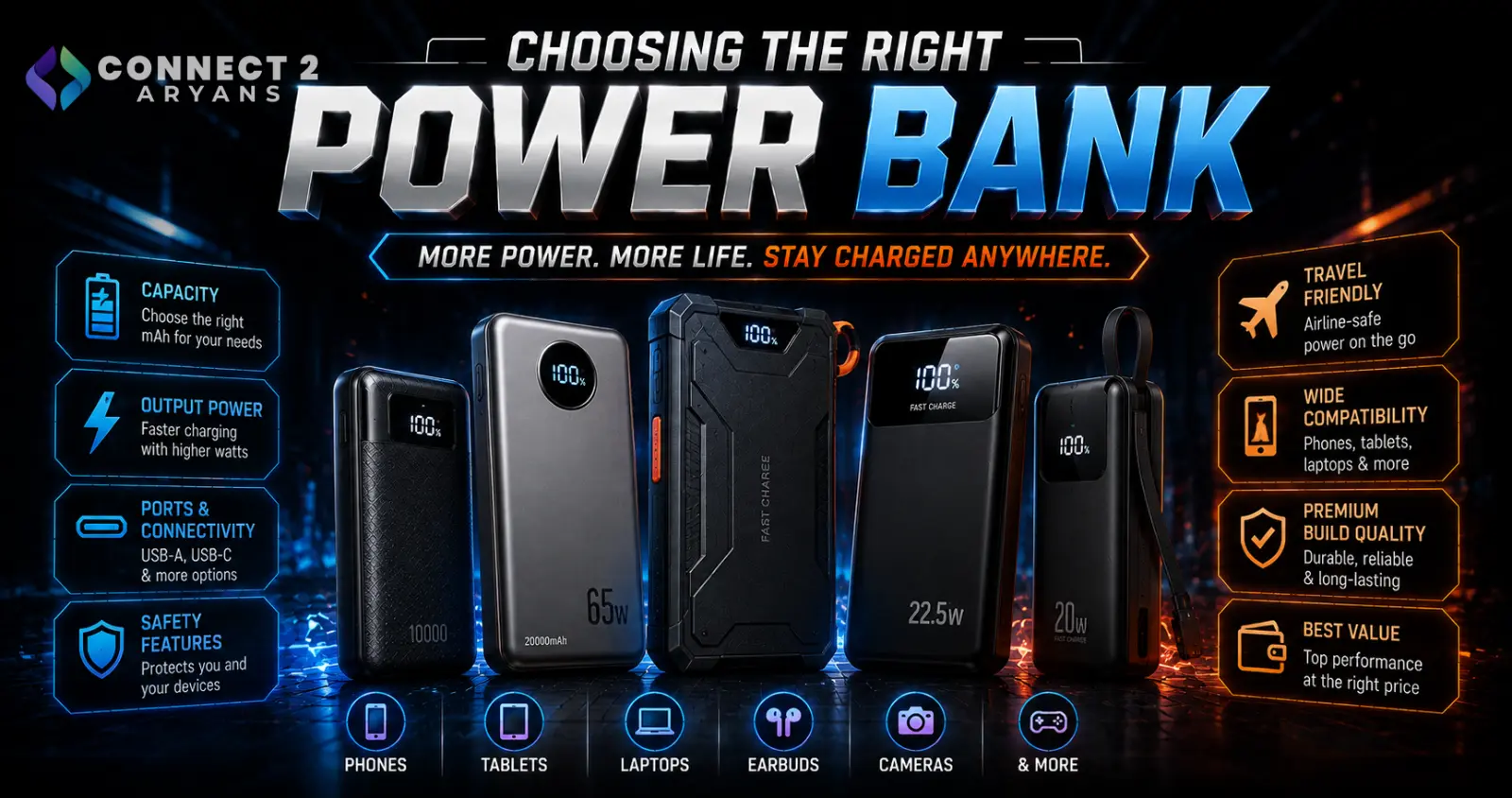
A bigger mAh number on the box isn't automatically the right choice — capacity, output wattage, and physical size all pull in different directions depending on whether you're topping up a phone once or trying to charge a laptop on a long trip. Here's how to choose the right Power Banks for how you actually use it.
Step 1: Choose the Right Capacity (mAh)
- 5,000–10,000 mAh — compact and lightweight, good for one to two phone charges, ideal for everyday carry or light daily top-ups
- 10,000–20,000 mAh — a solid middle ground, covering multiple phone charges or a partial laptop charge, popular for travel and extended days away from an outlet
- 20,000 mAh+ — needed for charging laptops fully, or covering multiple devices over several days without access to a wall outlet, at the cost of significantly more weight and size
Rule of thumb: don't just maximize capacity — a huge power bank you leave at home because it's too bulky to carry provides zero real-world benefit. Match capacity to how far from an outlet you actually expect to be.
Step 2: Check Output Wattage for Your Devices
- Phones — typically need 18–30W for fast charging; check your specific phone's maximum supported charging wattage
- Tablets — generally in a similar range to phones, sometimes slightly higher
- Laptops — need significantly more power, often 45–100W depending on the laptop, and require a power bank explicitly supporting USB-PD at that wattage level
If you want a power bank capable of charging a laptop, don't assume a high-mAh power bank automatically supports laptop-level wattage output — check the specific PD wattage rating, since capacity and output wattage are two separate specs.
Step 3: Charging Protocol Support
- USB Power Delivery (USB-PD) — the standard for fast charging across most current phones, tablets, and especially laptops via USB-C
- Quick Charge (QC) — still relevant for some Android devices, generally less universal than USB-PD for the newest devices
- Confirm the power bank supports the specific protocol and wattage your device needs — without matching support, you'll get slow, standard charging even from a "fast charging" power bank
Step 4: Port Count and Types
- Multiple ports let you charge more than one device simultaneously, useful for travel with a phone, earbuds case, and tablet all needing power
- Check how total output wattage is distributed across ports when multiple devices are connected — some power banks reduce per-port wattage significantly when multiple ports are active at once
- USB-C output is worth prioritizing for compatibility with most current devices and higher wattage support compared to USB-A
Step 5: Pass-Through Charging
- Pass-through charging lets you charge a connected device while the power bank itself is simultaneously being charged from a wall outlet — useful for minimizing downtime when you need to top up both at once
- Not all power banks support this reliably — check reviews specifically confirming stable pass-through charging, since some models handle this better than others
Step 6: Size, Weight, and Portability
- Higher capacity generally means more weight and bulk — there's a genuine trade-off between capacity and how comfortably it fits in a bag or pocket
- If you're buying primarily for daily commuting or pocket carry, prioritize a smaller, lighter power bank even at reduced capacity
- If you're buying for travel or extended outdoor use, a larger capacity is worth the added bulk since you'll likely be carrying it in a bag rather than a pocket anyway
Step 7: Safety Certifications
- Look for power banks with recognized safety certifications, particularly important for lithium battery products where quality control genuinely matters for safety
- Avoid unusually cheap, unbranded power banks with no clear certification — battery safety is not an area worth cutting corners on price alone
Popular Power Bank Brands
Common Mistakes to Avoid
- Buying based on mAh capacity alone without checking output wattage against your actual devices
- Assuming a high-capacity power bank automatically supports laptop-level PD charging wattage
- Choosing a power bank too bulky to actually carry regularly, defeating its portable purpose
- Buying an unbranded, uncertified power bank to save money on a lithium battery product
Final Thoughts
The right power bank comes down to matching capacity and output wattage to your actual devices and how far you'll be from an outlet — not simply choosing the highest mAh number available. A smaller, well-matched power bank you actually carry with you beats a massive one that stays in a drawer because it's too bulky.
Browse our full range of Power Banks from UGREEN and Xiaomi on Connect2Aryans, with warranty support included.