
Choosing the Right Charging Adapter
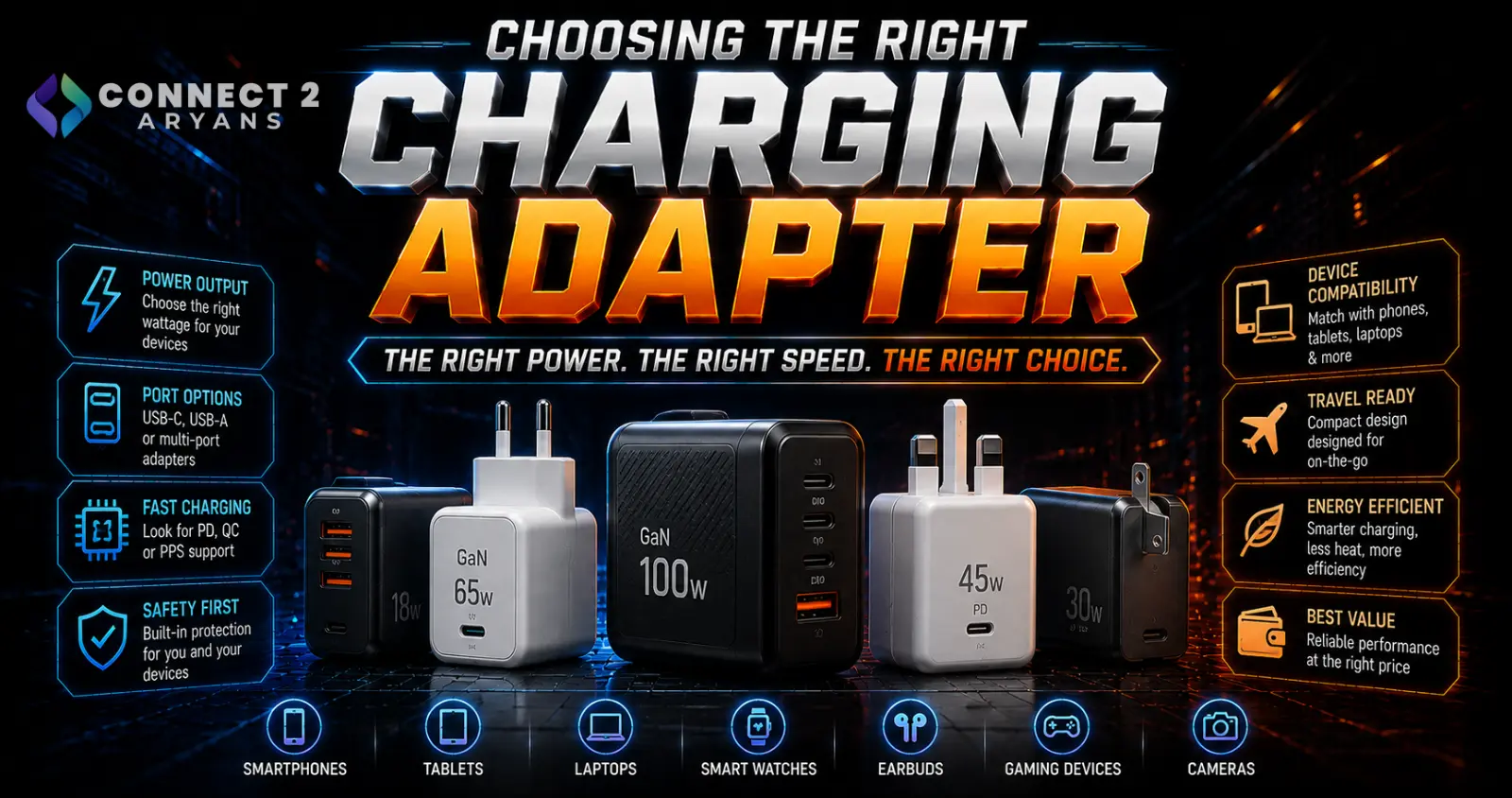
Not every charger works the same way with every device — wattage, port count, and charging protocol all affect whether you actually get fast charging, or just a very slow trickle. Here's how to choose the right [[C: Charging Adapters]] for what you're actually charging.
Step 1: Match Wattage to Your Device
- 18–20W — sufficient for most phones' fast charging, though check your specific phone's maximum supported wattage since exceeding it doesn't provide extra benefit
- 30–65W — the practical range for most laptops, tablets, and higher-power phone charging combined
- 65–100W+ — needed for higher-power laptops, especially gaming or professional laptops with more demanding charging requirements
Check your specific device's maximum charging wattage before buying — a higher-wattage charger won't damage a lower-wattage device (most devices only draw what they need), but it also won't charge faster than the device's own limit allows.
Step 2: GaN vs Traditional Chargers
- GaN (Gallium Nitride) chargers — use newer semiconductor technology to deliver higher wattage in a significantly smaller, cooler-running form factor compared to traditional chargers
- Traditional silicon chargers — bulkier for the same wattage output, generally cheaper, but less practical for travel or multi-device charging stations
Recommendation: GaN chargers are worth the modest price premium for anyone charging laptops or multiple devices, given the meaningful size and heat reduction — especially useful for travel.
Step 3: Single-Port or Multi-Port?
- Single-port chargers — simpler, often cheaper, and can typically deliver their full rated wattage to one device
- Multi-port chargers — convenient for charging multiple devices from one outlet, but check how power is distributed between ports, since many multi-port chargers reduce available wattage per port when multiple devices are connected simultaneously
If you regularly charge a laptop and phone simultaneously, check the multi-port charger's specific wattage breakdown per port combination, not just its total rated wattage.
Step 4: Charging Protocols — USB-PD and Quick Charge
- USB Power Delivery (USB-PD) — the most widely adopted fast-charging standard, supported across most current phones, tablets, and laptops with USB-C charging
- Quick Charge (QC) — an older, still-common protocol on some Android devices, generally less universal than USB-PD on newer devices
- Confirm both your charger and device support a matching protocol — mismatched charger/device protocol support means you'll get standard, slower charging even from a "fast charger"
Step 5: Cable Compatibility
- A high-wattage charger is only as fast as the cable connecting it — check that any included or separately purchased cable is rated to handle the charger's full wattage
- Not all USB-C cables support the same power delivery wattage despite looking identical — a cable rated for lower wattage will bottleneck a higher-wattage charger
- If charging a laptop via USB-C, confirm the cable specifically supports the wattage your laptop needs, since some cables are data-only or lower-power-rated
Step 6: Port Type — USB-C vs USB-A
- USB-C — the current standard for most fast charging, supporting higher wattages and USB-PD across phones, tablets, and laptops
- USB-A — still common for compatibility with older devices and accessories, though generally limited to lower wattage and older charging protocols
If you're buying new charging gear today, prioritize USB-C output for the best fast-charging compatibility with current devices.
Popular Charging Adapter Brands
- UGREEN
- Xiaomi
Common Mistakes to Avoid
- Buying a charger without checking your device's actual maximum supported wattage
- Using a low-wattage-rated cable with a high-wattage charger, bottlenecking charging speed
- Assuming a multi-port charger delivers full rated wattage to every port simultaneously without checking the actual per-port breakdown
- Mismatching charging protocols (USB-PD vs Quick Charge) between charger and device, resulting in slower-than-expected charging
Final Thoughts
The right charging adapter comes down to matching wattage and charging protocol to your specific device, then confirming your cable can actually handle that wattage without bottlenecking it. GaN chargers are worth the small premium for their size and heat advantages, especially if you're charging laptops or traveling with multiple devices.
Browse our full range of Charging Adapters from UGREEN and Xiaomi on Connect2Aryans, with warranty support included.