
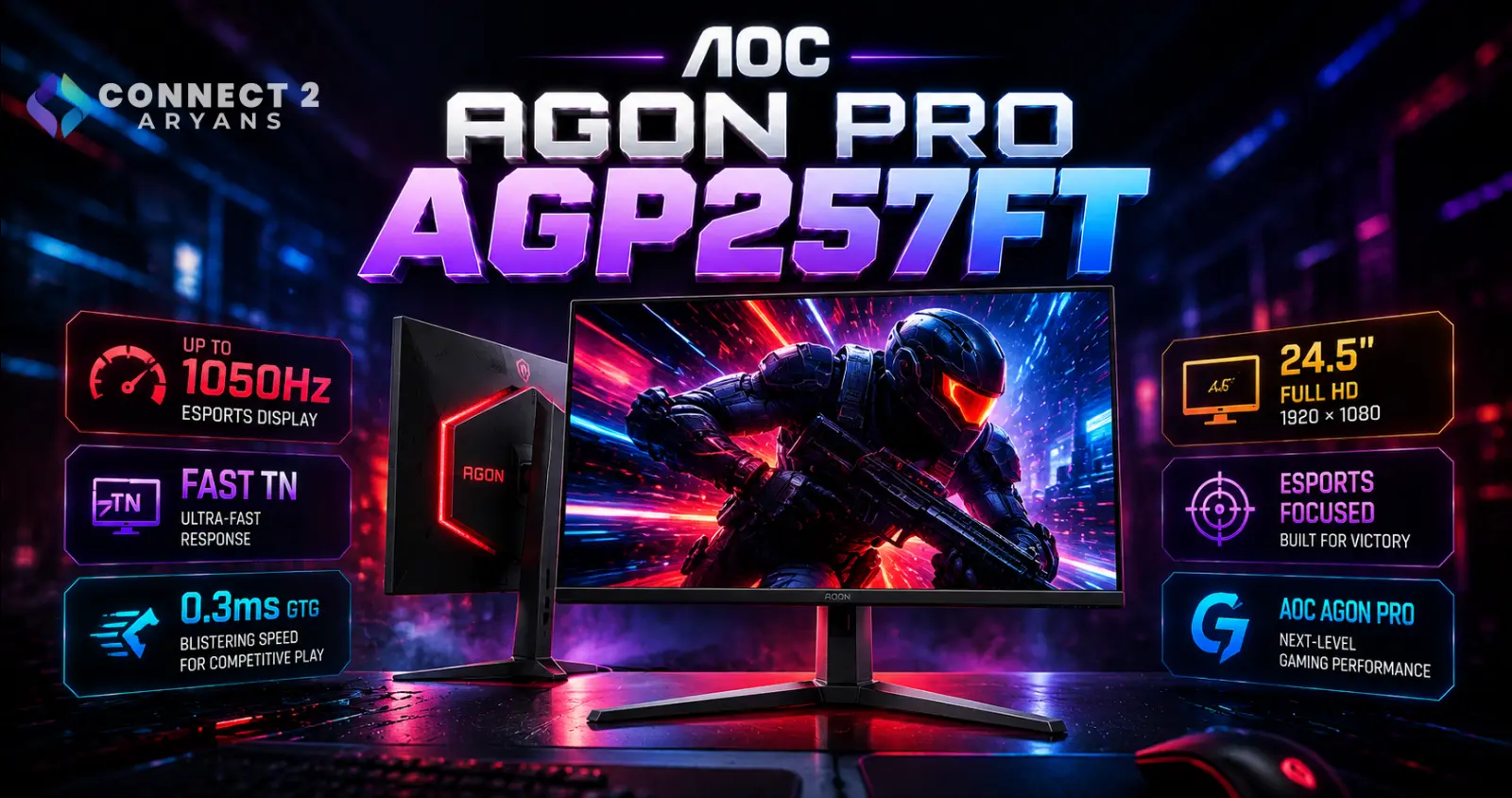
AOC Unveils 1000Hz Gaming Monitor: AGON PRO AGP257FT Pushes Esports Displays to 1050Hz
Introduction
Gaming-monitor refresh rates have crossed another major milestone.
For years, 144Hz was considered fast.
Then competitive gaming moved toward:
240Hz.
After that came:
360Hz.
More recently, premium esports displays have pushed into:
480Hz and 500Hz.
Now we are entering an entirely different category.
AOC has officially announced the AGON PRO AGP257FT, a 24.5-inch Full HD esports gaming monitor running at a native:
1000Hz.
And that is not even its maximum advertised refresh rate.
AOC says the monitor can be overclocked to:
1050Hz.
The AGP257FT is therefore the fastest monitor currently announced in AOC's AGON gaming lineup and represents another step toward four-digit refresh rates becoming real commercial gaming-monitor specifications.
But 1000Hz raises an obvious question:
Does anyone actually need a monitor this fast?
Before answering that, it helps to understand what AOC has built and what 1000Hz means in practical terms.
AOC AGON PRO AGP257FT: What Has Been Announced?
AGON by AOC announced the AGP257FT on September 30, 2026, describing it as the fastest monitor in its lineup to date.
The monitor uses a:
24.5-inch Full HD display
with a resolution of:
1920 × 1080.
Its headline specification is a:
1000Hz native refresh rate
with an optional overclock reaching:
1050Hz.
AOC is positioning the display specifically toward:
professional esports players,
competitive gamers,
and users playing extremely fast-paced titles.
This is not intended to be a high-resolution cinematic gaming monitor.
It is built around one main objective:
speed.
The Key Specifications
According to AOC's official announcement, the AGON PRO AGP257FT includes:
| Specification | AOC AGON PRO AGP257FT |
|---|---|
| Screen Size | 24.5 inches |
| Resolution | 1920 × 1080 Full HD |
| Panel | Oxide-based Fast IPS |
| Native Refresh Rate | 1000Hz |
| Maximum OC Refresh Rate | 1050Hz |
| Minimum GtG Response | 0.3ms |
| MPRT | 0.1ms |
| Adaptive Sync | NVIDIA G-SYNC Compatible |
| HDR | VESA DisplayHDR 400 |
| Typical Brightness | 450 nits |
| sRGB Coverage | 99% |
| DCI-P3 Coverage | 90% |
| DisplayPort | DisplayPort 2.1 |
| HDMI | HDMI 2.1 |
| Expected Availability | Q1 2027 |
AOC has not announced a Pakistan price.
In fact, the company's announcement does not yet provide general retail pricing, so any price prediction at this stage would be speculation.
What Does a 1000Hz Gaming Monitor Actually Mean?
Refresh rate measures how many times a display can update its image every second.
At:
60Hz
the display can refresh up to 60 times each second.
At:
144Hz
it can refresh 144 times.
At:
240Hz
it can refresh 240 times.
The AGP257FT reaches:
1000Hz.
That means a complete refresh interval occurs approximately every:
1 millisecond.
At its 1050Hz overclock, that interval drops slightly below one millisecond.
This does not mean the monitor has “1ms response time.”
Refresh interval and pixel response time are separate measurements.
AOC separately rates the AGP257FT at a minimum:
0.3ms GtG
and:
0.1ms MPRT.
How Much Faster Is 1000Hz Than 500Hz?
The difference becomes easier to understand when looking at frame intervals.
| Refresh Rate | Approx. Time Between Refreshes |
|---|---|
| 60Hz | 16.67ms |
| 120Hz | 8.33ms |
| 144Hz | 6.94ms |
| 240Hz | 4.17ms |
| 360Hz | 2.78ms |
| 500Hz | 2.00ms |
| 1000Hz | 1.00ms |
| 1050Hz | ~0.95ms |
Moving from 500Hz to 1000Hz cuts the display refresh interval from:
2ms to 1ms.
That is technically significant.
However, the practical improvement is not comparable to moving from:
60Hz to 120Hz.
Refresh-rate improvements experience diminishing returns.
Each additional increase removes a smaller absolute amount of time.
Why Is AOC Using Full HD Instead of 1440p or 4K?
The AGP257FT runs at:
1920 × 1080.
That might sound surprising when premium monitors increasingly use QHD or 4K resolutions.
But this monitor has a completely different priority.
To take advantage of an extremely high refresh rate, the PC must generate extremely high frame rates.
Rendering:
1000 FPS at 4K
would be enormously more demanding than rendering the same frame rate at:
1080p.
Competitive esports players also commonly favor lower resolutions and smaller screen sizes because these configurations can help maximize:
frame rate,
visibility,
and responsiveness.
The 24.5-inch Full HD format therefore fits the AGP257FT's esports focus.
The AGP257FT Uses an Oxide-Based Fast IPS Panel
One of the most interesting parts of AOC's announcement is the panel technology.
The monitor uses what AOC describes as an:
oxide-based Fast IPS panel.
According to AOC, the architecture combines fast-response liquid-crystal materials with an integrated GIA circuit design.
The goal is to overcome voltage-response limitations that make conventional LCD technology increasingly difficult to drive at extreme refresh rates.
This is important.
Reaching 1000Hz is not simply a matter of telling an ordinary 240Hz IPS panel to run four times faster.
The display electronics and panel itself have to respond quickly enough for those refreshes to remain useful.
Why Pixel Response Still Matters at 1000Hz
A monitor can refresh extremely quickly while still suffering from poor motion clarity if its pixels cannot transition quickly enough.
At 1000Hz, the display has only around:
1ms per refresh cycle.
If pixel transitions take substantially longer than the refresh interval, previous image information can remain visible while the next refresh arrives.
That can produce:
ghosting,
smearing,
or blurred moving objects.
AOC therefore pairs the 1000Hz panel with a claimed minimum:
0.3ms GtG response
and:
0.1ms MPRT.
As always, advertised response-time figures should not be treated as complete real-world performance measurements.
Independent testing will be important once retail units become available.
Motion Blur Reduction Plus Is Included
AOC also includes:
Motion Blur Reduction Plus — MBR+.
This feature is designed to reduce perceived blur during rapid motion.
That is particularly relevant for games involving:
fast camera movement,
flick shots,
rapid target tracking,
and quick directional changes.
Competitive FPS titles are the obvious target.
Examples of workloads that can benefit from extreme motion clarity include games where players prioritize responsiveness over graphical detail.
NVIDIA G-SYNC Compatible Support
The AGP257FT is also listed as:
NVIDIA G-SYNC Compatible.
Variable refresh rate technologies synchronize monitor refresh behavior with compatible GPU frame delivery.
This helps reduce issues such as:
screen tearing
and:
visible stuttering
when frame rate changes.
A 1000Hz monitor does not eliminate the usefulness of synchronization technologies.
In fact, sustaining exactly 1000 FPS continuously would be extremely difficult in most games and hardware configurations.
Can a Gaming PC Actually Reach 1000 FPS?
This is the biggest practical question.
A monitor refreshing at 1000Hz does not automatically make a game run at:
1000 FPS.
Refresh rate and frame rate are different.
The monitor determines how frequently it can update.
The PC determines how quickly it can render new frames.
To make maximum use of a 1000Hz monitor, the system needs exceptionally high frame rates.
That means:
a very fast CPU,
a powerful GPU,
fast memory,
low game settings where appropriate,
and, most importantly,
a game engine capable of producing those frame rates.
Most AAA Games Will Not Run at 1000 FPS
Modern AAA games featuring:
ray tracing,
complex environments,
advanced physics,
high-resolution textures,
and sophisticated lighting
are not the intended workload for a 1000Hz display.
Even extremely powerful gaming PCs will generally operate far below 1000 FPS in graphically intensive modern games.
That does not make the monitor useless.
A high-refresh monitor can still operate when the game runs below its maximum refresh capability.
But the full 1000Hz specification is clearly targeted at:
competitive esports workloads.
Esports Is Where 1000Hz Makes More Sense
Competitive games can behave very differently from cinematic AAA titles.
Esports players often deliberately use:
lower graphics settings,
1080p resolution,
performance modes,
and extremely powerful CPUs
to maximize frame rate.
The objective is not:
maximum visual quality.
It is:
minimum latency and maximum motion clarity.
That makes titles capable of extremely high frame rates much more suitable for four-digit-refresh displays.
1000Hz Does Not Mean You Need Exactly 1000 FPS
This is another misconception worth clearing up.
Your FPS does not need to exactly match your monitor's refresh rate at every moment.
A game running at:
500 FPS
on a 1000Hz monitor does not suddenly become unplayable.
Likewise, today's 500Hz monitors do not require exactly 500 FPS at all times.
Frame rate, refresh rate, frame pacing, synchronization and latency all interact.
However, the closer a system gets to producing very high frame rates consistently, the more opportunity there is to exploit an extreme-refresh display.
Why 1050Hz Instead of Stopping at 1000Hz?
The native panel specification is:
1000Hz.
AOC provides an overclock mode reaching:
1050Hz.
From a practical perspective, the jump from 1000Hz to 1050Hz is very small.
The refresh interval changes from:
1.00ms
to approximately:
0.95ms.
That is a difference of only around:
0.05ms per refresh.
So the major technological milestone is clearly:
native 1000Hz.
The additional 50Hz demonstrates extra panel headroom, but buyers should not expect the difference between 1000Hz and 1050Hz to resemble the jump from 60Hz to 144Hz.
AOC Has Not Sacrificed IPS Color Completely
Although speed is the priority, AOC is not using a basic esports-only TN specification.
The Fast IPS panel is rated for:
99% sRGB
and:
90% DCI-P3
coverage.
AOC also states that each unit will ship with a factory:
color and brightness uniformity report.
That suggests the company wants the display to provide reasonable color performance alongside extreme speed.
Still, users buying primarily for:
professional color grading,
high-resolution content creation,
or cinematic image quality
would likely prioritize very different monitor characteristics.
VESA DisplayHDR 400 Is Included
The AGP257FT carries:
VESA DisplayHDR 400
support.
This gives it a formal entry-level HDR certification rather than simply generic HDR input support.
However, HDR is clearly not the main reason this monitor exists.
Its primary selling point remains:
1000Hz competitive gaming.
Users looking specifically for premium HDR performance may instead prioritize technologies such as:
Mini LED,
high-zone-count local dimming,
OLED,
or:
QD-OLED.
AOC Lists 450 Nits Typical Brightness
AOC rates the monitor at:
450 nits typical brightness.
That is relatively bright for an esports-oriented IPS gaming monitor.
The display also uses:
20 local-dimming zones.
Twenty zones should not be confused with the hundreds or thousands of zones available in some Mini LED displays.
Again, the AGP257FT's design priorities are clear:
speed first.
DisplayPort 2.1 and HDMI 2.1 Connectivity
Driving extremely high refresh rates requires substantial display-interface capability.
AOC equips the AGP257FT with:
DisplayPort 2.1
and:
HDMI 2.1.
It also includes a:
USB hub.
The presence of current-generation display connectivity is important for a monitor operating at such unusual refresh rates.
Users will still need compatible graphics hardware and appropriate cables/configuration to access supported display modes.
1000Hz Is Part of a Larger Monitor Industry Race
The AGP257FT is not appearing in isolation.
Gaming-monitor manufacturers have been rapidly increasing refresh rates.
The market has already progressed through:
144Hz,
240Hz,
360Hz,
480Hz,
500Hz,
and beyond.
AOC's announcement confirms that:
four-digit refresh rates are now becoming commercial gaming-display products rather than laboratory demonstrations.
This is significant even if most gamers do not need 1000Hz today.
Technology introduced at the extreme high end often influences more mainstream products later.
Connect2Aryans Already Carries 500Hz-Class Gaming Displays
For some perspective, gaming monitors currently available through Connect2Aryans already include models reaching:
500Hz.
The AOC AG276QKD2, for example, combines a:
500Hz refresh rate
with:
QHD resolution
and:
QD-OLED panel technology.
That represents a very different design philosophy from the upcoming AGP257FT.
The AG276QKD2 prioritizes a combination of:
high refresh,
QHD resolution,
OLED response,
contrast,
and image quality.
The AGP257FT instead pushes:
raw LCD refresh rate to 1000Hz and beyond.
View the AOC AG276QKD2 500Hz QD-OLED Gaming Monitor on Connect2Aryans.
500Hz QD-OLED vs 1000Hz Fast IPS: An Interesting New Trade-Off
The arrival of 1000Hz LCDs creates an interesting question for competitive gamers.
Would you rather have:
500Hz QD-OLED
with exceptionally fast pixel response, deep blacks and QHD resolution?
Or:
1000Hz Fast IPS
at Full HD with half the refresh interval?
There is no simple answer.
Refresh rate alone does not determine motion clarity.
Important factors include:
pixel response,
persistence,
strobing technology,
overshoot,
frame rate,
input latency,
and game performance.
Independent measurements will therefore be especially important when the AGP257FT becomes available.
Does 1000Hz Make 500Hz Obsolete?
No.
The existence of a faster specification does not make existing high-refresh monitors suddenly slow.
At 500Hz, a display already refreshes every:
2 milliseconds.
That is an extremely short interval.
Moving to 1000Hz reduces it to:
1 millisecond.
Technically, that is a major doubling of refresh rate.
Perceptually, however, diminishing returns mean the improvement will be much subtler than earlier refresh-rate jumps.
A 500Hz display remains an extremely fast gaming monitor.
Does 1000Hz Make 240Hz Obsolete?
Definitely not.
240Hz remains highly suitable for competitive gaming.
A 240Hz display refreshes approximately every:
4.17ms.
For many gamers, 240Hz provides an excellent combination of:
smooth motion,
high attainable frame rates,
resolution options,
image quality,
and price.
The AGP257FT is aimed at the extreme edge of esports performance.
It should not be interpreted as a new minimum requirement for gaming.
144Hz and 165Hz Are Still Perfectly Relevant
The arrival of 1000Hz monitors can make ordinary gaming displays sound outdated.
They are not.
A gamer playing:
story-driven titles,
open-world games,
racing games,
RPGs,
strategy games,
or visually demanding AAA releases
may benefit far more from:
higher resolution,
better HDR,
stronger contrast,
OLED,
Mini LED,
or simply a better GPU
than from moving from 165Hz to four-digit refresh rates.
Monitor specifications should match the games you actually play.
How Much GPU Power Will 1000Hz Require?
There is no single GPU requirement because the monitor does not determine game performance by itself.
Reaching very high FPS depends on:
game,
resolution,
graphics settings,
CPU,
GPU,
RAM,
drivers,
and engine limitations.
At Full HD and competitive settings, some lightweight esports games can reach extremely high frame rates on high-end hardware.
But in many situations, the CPU becomes the limiting factor before the GPU.
This is why a 1000Hz esports setup needs to be designed as a complete system rather than simply pairing the monitor with the most expensive graphics card.
CPU Performance Becomes Extremely Important
At low resolution and very high frame rates, the GPU may finish rendering quickly enough that the CPU becomes the bottleneck.
The CPU must repeatedly handle:
game logic,
draw calls,
physics,
input processing,
and other work
at an extremely high rate.
That means a 1000Hz-targeted esports PC may benefit heavily from:
strong gaming CPU performance,
fast memory,
low latency,
and careful system optimization.
Simply upgrading the graphics card may not produce 1000 FPS.
Why Full HD Still Exists in High-End Esports
The AGP257FT is another reminder that:
higher resolution is not always the priority.
For immersive gaming:
4K can be excellent.
For a balanced gaming system:
1440p can be excellent.
For extreme esports:
1080p still has major advantages.
It reduces rendering workload and allows the PC to target much higher frame rates.
At 24.5 inches, Full HD also remains a familiar resolution and screen size for competitive setups.
Is 1000Hz Visible to the Human Eye?
Questions about human vision are often oversimplified into claims such as:
“The eye can only see X FPS.”
Human vision does not operate like a monitor with a fixed frame-rate limit.
Perception of:
motion,
flicker,
latency,
object tracking,
and temporal changes
depends on many variables.
The more useful question is:
Does moving from 500Hz to 1000Hz provide a meaningful competitive or perceptual improvement for a particular user and workload?
That requires proper testing.
It cannot be answered simply by claiming that human vision has a fixed Hz limit.
The Biggest Benefit May Be Reduced Display Latency
Higher refresh rates shorten the time between display updates.
The theoretical refresh interval falls from:
4.17ms at 240Hz
to:
2ms at 500Hz
and:
1ms at 1000Hz.
That can reduce one component of the total latency chain.
But complete gaming latency also includes:
mouse input,
CPU processing,
game engine,
GPU rendering,
render queue,
display processing,
and pixel response.
A 1000Hz monitor cannot eliminate latency elsewhere in the system.
Who Is the AGP257FT Actually For?
The target audience is relatively narrow.
It makes the most sense for:
professional esports players
serious competitive FPS players
high-level competitive gamers
users deliberately building ultra-high-FPS PCs
and:
enthusiasts interested in cutting-edge display technology.
It makes less sense as a primary purchase for someone who mainly plays graphically demanding single-player games at high settings.
Who Probably Does Not Need 1000Hz?
You probably do not need a 1000Hz monitor simply because it exists if you primarily play:
cinematic AAA games,
RPGs,
simulation titles,
casual games,
4K games,
or console titles.
Likewise, if your PC normally produces:
80–150 FPS,
there are likely more useful places to invest your gaming budget.
A better GPU,
higher-resolution monitor,
OLED display,
more storage,
or another system upgrade
may produce a more noticeable improvement.
When Will the AOC AGP257FT Launch?
AOC says the AGON PRO AGP257FT is expected to become available from:
Q1 2027.
That means the monitor is announced but is not yet a generally available product as of October 2, 2026.
This distinction is important.
There is currently no reason to assume it is available in Pakistan.
AOC has also not provided Pakistan-specific:
pricing,
launch timing,
or retail availability.
Those details should only be discussed once officially confirmed.
What About Price?
AOC has not announced the general retail price in its September 30 announcement.
Therefore:
there is no verified Pakistan price for the AGP257FT at this time.
Any PKR figure would currently be speculation.
Its final value proposition will depend heavily on:
launch price,
competition,
independent testing,
and how many gamers can realistically exploit its extreme refresh rate.
What This Means for Gaming Monitors in 2027
The bigger story is not necessarily one individual AOC monitor.
It is the direction of the display industry.
A few years ago:
360Hz sounded extreme.
Now:
500Hz-class monitors are already commercially available.
And 1000Hz panels are entering announced consumer gaming products.
The next stage of gaming-monitor competition may increasingly involve different approaches.
Some manufacturers will push:
extreme refresh rate.
Others will emphasize:
OLED response and contrast.
Others may prioritize:
Mini LED HDR.
And premium displays will continue balancing:
resolution,
refresh rate,
motion clarity,
HDR,
and panel quality.
For buyers, that means there will be more choices—but also more specifications to understand.
What Pakistani Gamers Should Take From This News
The AGP257FT is exciting technology.
But Pakistani PC buyers should not interpret this announcement as a reason to delay purchasing a good:
144Hz,
165Hz,
240Hz,
360Hz,
or 500Hz
monitor today.
A gaming monitor should be selected according to:
your GPU,
CPU,
games,
target FPS,
resolution preference,
panel preference,
and budget.
The best monitor is not automatically the one with the largest Hz number.
For most gamers, balancing:
resolution + refresh rate + panel quality + GPU capability
remains more important than chasing a specification their PC cannot realistically use.
Browse Gaming Monitors on Connect2Aryans.
Frequently Asked Questions
What is the AOC AGON PRO AGP257FT?
The AGP257FT is an upcoming 24.5-inch Full HD esports gaming monitor announced by AGON by AOC. It uses an oxide-based Fast IPS panel and has a native 1000Hz refresh rate.
Is the AOC AGP257FT really 1000Hz?
Yes. AOC officially specifies a native 1000Hz refresh rate.
Can the AGP257FT reach 1050Hz?
Yes. AOC says the monitor can be overclocked to 1050Hz.
What resolution does the AGP257FT use?
It uses a 1920 × 1080 Full HD resolution.
Why isn't a 1000Hz monitor 1440p or 4K?
The AGP257FT is designed primarily for extreme competitive gaming. Full HD reduces rendering workload and makes extremely high frame rates more achievable than higher resolutions.
What panel does the AOC AGP257FT use?
AOC says it uses an oxide-based Fast IPS panel designed for ultra-high-refresh operation.
What is its response time?
AOC specifies a minimum 0.3ms GtG response and 0.1ms MPRT.
Does it support G-SYNC?
AOC lists the AGP257FT as NVIDIA G-SYNC Compatible.
Does it support HDR?
Yes. AOC lists VESA DisplayHDR 400 support.
What ports does it have?
AOC's announced specifications include DisplayPort 2.1, HDMI 2.1 and USB connectivity.
Do I need 1000 FPS for a 1000Hz monitor?
No. The monitor can operate when a game runs below 1000 FPS. However, achieving extremely high frame rates gives the system more opportunity to benefit from the monitor's maximum refresh capability.
Is 1000Hz twice as fast as 500Hz?
In refresh-rate terms, yes. 500Hz refreshes every approximately 2ms, while 1000Hz reduces that interval to approximately 1ms.
Is 1000Hz twice as smooth as 500Hz?
Not necessarily in perceived experience. Refresh rate doubles, but diminishing returns mean the visual difference becomes progressively smaller at very high refresh rates.
Is 1000Hz better than 500Hz OLED?
Refresh rate alone cannot answer that. OLED can offer extremely fast pixel response, superior black levels and other image-quality advantages, while the AGP257FT provides a substantially higher refresh rate. Independent testing of motion clarity and latency is needed for meaningful comparison.
When will the AOC AGP257FT launch?
AOC says availability is expected from Q1 2027.
What is the AOC AGP257FT price in Pakistan?
No official Pakistan price has been announced as of October 2, 2026.
Conclusion
Gaming monitors have officially entered the:
1000Hz era.
AOC's newly announced AGON PRO AGP257FT delivers:
1000Hz natively
and can be overclocked to:
1050Hz.
It does this at:
24.5 inches
and:
1920 × 1080
using an oxide-based Fast IPS panel developed specifically around extreme refresh performance.
The numbers are remarkable.
At 1000Hz, the refresh interval falls to approximately:
1 millisecond.
That is half the interval of a 500Hz display and less than one quarter of the interval at 240Hz.
But the AGP257FT also demonstrates an important lesson about modern gaming hardware:
bigger numbers do not automatically make a product better for every gamer.
A 1000Hz monitor makes the most sense when paired with a PC and game capable of producing extraordinarily high frame rates.
That puts its clearest use case in:
professional and high-level esports.
For the average gamer, a balanced 1440p 165Hz, 240Hz, OLED or other high-quality gaming display may still provide a much more meaningful overall upgrade.
What makes the AGP257FT important is what it tells us about where gaming monitors are heading.
500Hz is no longer the endpoint.
Four-digit refresh rates are becoming commercial products.
AOC expects the AGP257FT to arrive in Q1 2027, and pricing has not yet been announced.
For now, the 1000Hz barrier has officially been crossed—and the next battle in esports display technology has begun.
Browse Gaming Monitors on Connect2Aryans:
https://www.connect2aryans.com/monitors-price-in-pakistan/gaming
AOC AG276QKD2 26.5-inch QHD 500Hz QD-OLED Gaming Monitor:
https://www.connect2aryans.com/aoc-ag276qkd2-265-qhd-qdoled-gaming-monitor-price-in-pakistan