
AMD Radeon RX 9070 GRE Goes Global — Is It Worth Buying at $549?
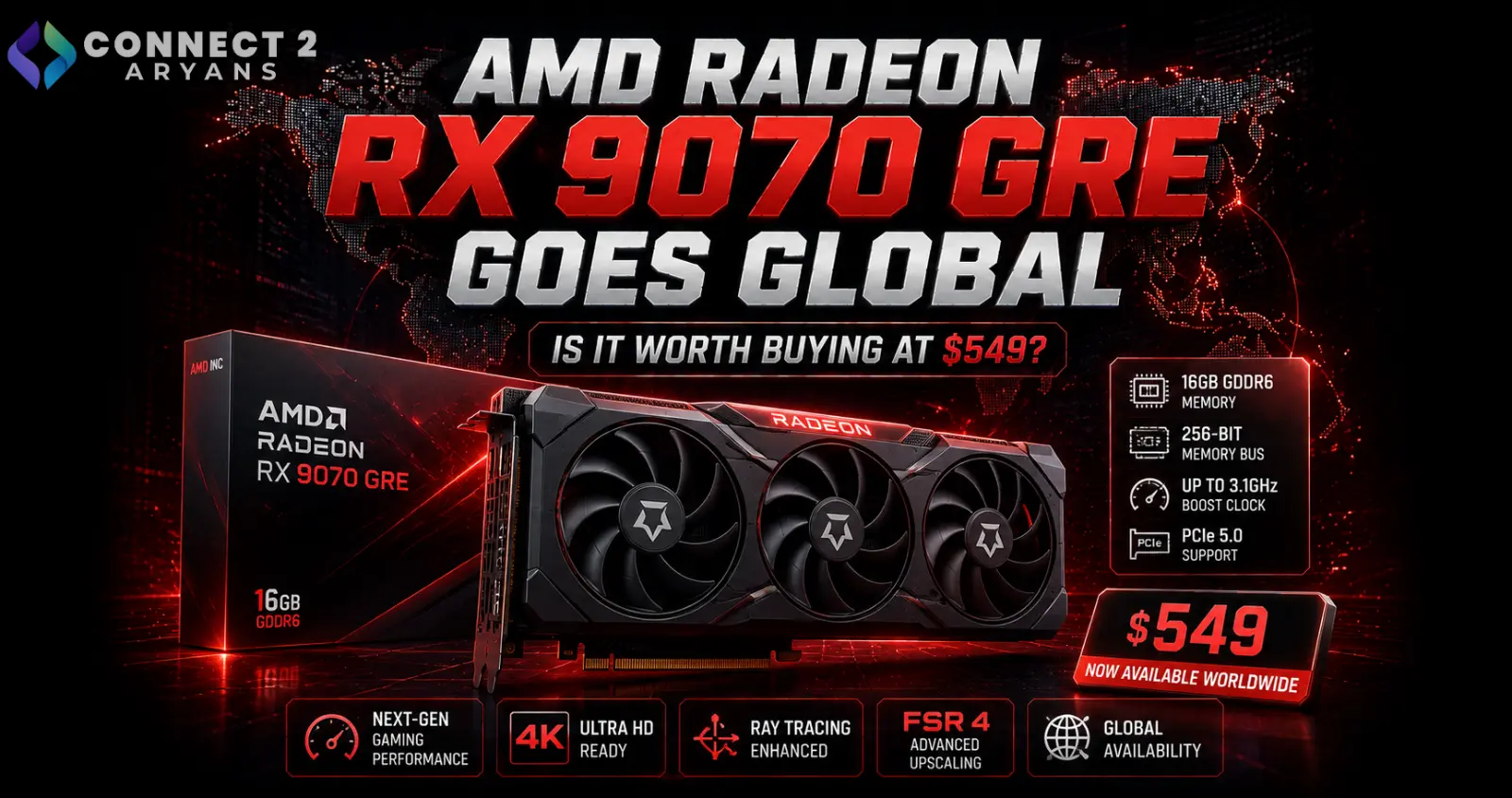
AMD's Radeon RX 9070 GRE — previously sold only in China — has now launched worldwide at $549, filling a price gap in AMD's RDNA 4 lineup between the RX 9060 XT and the standard RX 9070. Here's what it actually offers, and whether it's worth considering for your next build.
What the RX 9070 GRE Actually Is
- Built on the same 4nm Navi 48 silicon as the standard RX 9070 and RX 9070 XT, but using a cut-down configuration
- 48 Compute Units, compared to 56 on the standard RX 9070 and 64 on the RX 9070 XT
- 12GB of GDDR6 memory on a 192-bit bus, versus 16GB on a 256-bit bus for the standard RX 9070
- A higher boost clock (up to 2.79 GHz) than the standard RX 9070, partially offsetting the reduced compute unit count
- Rated at 220W board power, and connects via PCIe 5.0 x16
In short: it's essentially a further cut-down version of the same chip powering AMD's higher RDNA 4 cards, positioned specifically to fill the gap between the RX 9060 XT and the full RX 9070.
How It Performs
Based on early independent testing following the global launch:
- The RX 9070 GRE consistently outperforms NVIDIA's RTX 5060 Ti 16GB in raster (non-ray-tracing) gaming performance at 1440p, supporting AMD's own performance positioning for that comparison
- Against the RTX 5070, results are closer but generally fall short of AMD's own claimed parity — independent reviews place the GRE performing between the RTX 5060 Ti and RTX 5070, rather than matching or exceeding the RTX 5070 as AMD's marketing suggested
- The reduced 12GB VRAM and narrower memory bus create a genuine bottleneck at 4K resolution and in ray-traced titles, particularly above 1080p — this card is built and positioned specifically for 1440p gaming, not higher resolutions or heavy ray tracing workloads
Where It Fits in AMD's Lineup
- RX 9060 XT — entry-level RDNA 4 option
- RX 9070 GRE — new $549 mid-tier option, positioned for solid 1440p gaming without reaching flagship pricing
- RX 9070 — the full, uncut version of the same chip, offering meaningfully more performance headroom
- RX 9070 XT — AMD's top current-generation RDNA 4 card
Who It's Actually a Good Fit For
- 1440p gamers prioritizing raster performance who don't need heavy ray tracing or 4K capability — this is squarely the GRE's strength
- Buyers comparing directly against the RTX 5060 Ti 16GB — the GRE holds a genuine raster performance and value edge in this specific comparison
- Value-conscious buyers who don't need top-tier VRAM headroom — 12GB is adequate for 1440p in most current titles, just not future-proofed the way 16GB options are
Who Should Consider Something Else
- 4K gamers or anyone prioritizing ray tracing performance — the VRAM and memory bandwidth limitations become a real constraint here
- Buyers who specifically want to match or exceed RTX 5070 performance — independent testing suggests the GRE falls short of that specific claim, even if it's closer to the RTX 5070 than the RTX 5060 Ti
- Anyone planning to keep the card for many years without upgrading — the reduced 12GB VRAM offers less long-term headroom than the standard 16GB RX 9070
System Requirements to Pair With It
- PSU: 600 - 650 Watts comfortably covers the GRE's 220W board power alongside the rest of a typical mid-range build
- VRAM consideration: if you're specifically comparing against cards with 16 GB VRAM, be clear-eyed that the GRE's 12GB is the trade-off made for its price positioning
Final Thoughts
The RX 9070 GRE is a genuinely competitive 1440p raster gaming option at $549, particularly against NVIDIA's RTX 5060 Ti — but AMD's claimed parity with the RTX 5070 doesn't fully hold up under independent testing, and the 12GB VRAM/192-bit bus combination is a real limiting factor for 4K or heavy ray tracing use. If your target is solid 1440p raster gaming performance at a mid-tier price, it's a legitimate option worth comparing directly against the RTX 5060 Ti before deciding.
Browse our full range of Graphics Card options from AMD and NVIDIA on Connect2Aryans, with warranty support included.